Introduction & Index
Introduction
Quick start: use the Guide Index to the left to find treatises on your topic.
Use treatises--books on legal topics--to begin your research. They will help you save time by providing explanation, analysis, context, and tips on the most relevant primary sources.
Treatises range from single volume overviews for students to extensively detailed multi-volume sets for practitioners. They may come in the form of bound books updated with pocket parts or supplements, or in the form of loose-leafs with easily replaced pages.
If you need help finding a relevant treatise, this guide will provide you with some of the most useful titles in each subject. We have noted if and where the treatise is available on online. Please keep in mind that this availability may change without notice.
Note: this guide now contains blurbs about and contents of the books where available. This text is taken from info provided by the publishers and does not imply any special endorsement.
-
HLS Library Guide to Secondary Sources.For more about using treatises, see the HLS Library Guide to Secondary Sources.
CC License

This guide is licensed under a Creative Commons Attribution-Noncommercial-Share Alike 3.0 United States License.
You may reproduce any part of it for noncommercial purposes as long as credit is included and it is shared in the same manner.
A-B
Topics Covered A-B
Hover over the A-B tab above to access these topics:
Administrative Law
Admiralty & Maritime Law
Agency, Partnerships, & Limited Liability Corporations
American Law & Jurisprudence
Animal Law
Antitrust Law
Art Law
Bankruptcy
Subject Guide

Administrative Law
Administrative Law
-
 Administrative Law Treatise
by
Call Number: KF5402 .D32 2010xISBN: 9780735580473Publication Date: 2009- (kept current with supplements)Lawyers and judges across the United States have discovered that when it comes to administrative law, there is really only one authority: Administrative Law Treatise by Richard J. Pierce. Cited by the courts more than 4,000 times, this definitive three volume work now in its Fifth Edition brings you analysis of the latest developments with all the practical guidance and knowledge you need to plan and present an effective case before the courts. When your clients confront government administrative action whether it's rulemaking, adjudication, or investigation, do what your colleagues do: turn to the undisputed leader in the field. Richard J. Pierce shows you the most effective approaches to any agency action, policy or procedure. You'll get answers to such questions as: Which due process protections do individuals and companies enjoy under administrative law? What are the limits of an agency's power to subpoena, inspect, and gain access to records? When must an agency provide an oral evidentiary hearing? How and when are agencies likely to use their rulemaking power to resolve factual disputes? Richard J. Pierce also provides a unique, in-depth treatment of agency discretionary power, especially in relation to evidence in oral hearings and other essential matters of practice. There's no need to look elsewhere for the law that governs such areas as: SEC rulemaking, Medicare and Medicaid Jurisdiction in telecommunications disputes Warrantless inspection of premises FOIA exemptions Agency power to make retroactive rules Immunity of agency employees Regulation of toxic substances in the workplace Allocation of gas and electric services Criteria for evidence of disability Control of regional transportation authorities INS deportation, and more. Administrative Law Treatise, Fifth Edition, provides incomparable authority and guidance on the administrative law governing these and virtually every other significant agency power or procedure. If you practice before government agencies, act as agency counsel, or are connected with appeals involving agencies, you'll find that courts listen to Richard J. Pierce.
Administrative Law Treatise
by
Call Number: KF5402 .D32 2010xISBN: 9780735580473Publication Date: 2009- (kept current with supplements)Lawyers and judges across the United States have discovered that when it comes to administrative law, there is really only one authority: Administrative Law Treatise by Richard J. Pierce. Cited by the courts more than 4,000 times, this definitive three volume work now in its Fifth Edition brings you analysis of the latest developments with all the practical guidance and knowledge you need to plan and present an effective case before the courts. When your clients confront government administrative action whether it's rulemaking, adjudication, or investigation, do what your colleagues do: turn to the undisputed leader in the field. Richard J. Pierce shows you the most effective approaches to any agency action, policy or procedure. You'll get answers to such questions as: Which due process protections do individuals and companies enjoy under administrative law? What are the limits of an agency's power to subpoena, inspect, and gain access to records? When must an agency provide an oral evidentiary hearing? How and when are agencies likely to use their rulemaking power to resolve factual disputes? Richard J. Pierce also provides a unique, in-depth treatment of agency discretionary power, especially in relation to evidence in oral hearings and other essential matters of practice. There's no need to look elsewhere for the law that governs such areas as: SEC rulemaking, Medicare and Medicaid Jurisdiction in telecommunications disputes Warrantless inspection of premises FOIA exemptions Agency power to make retroactive rules Immunity of agency employees Regulation of toxic substances in the workplace Allocation of gas and electric services Criteria for evidence of disability Control of regional transportation authorities INS deportation, and more. Administrative Law Treatise, Fifth Edition, provides incomparable authority and guidance on the administrative law governing these and virtually every other significant agency power or procedure. If you practice before government agencies, act as agency counsel, or are connected with appeals involving agencies, you'll find that courts listen to Richard J. Pierce. -
 A Guide to Federal Agency Rulemaking
by
Call Number: KF5411 .L83 2018ISBN: 9781641053167Publication Date: 2018The guide addresses the FTCA's waiver of sovereign immunity, its purpose, scope, exclusions, exceptions, and the procedures for presenting administrative tort claims5 and fi ling suit. It discusses the protections the FTCA may provide to federal employees sued in tort. It explains the FTCA's rules for damages and for financial matters, including attorneys' fees, costs, and interest. Finally, it examines the FTCA settlement process and recommends approaches to settlement negotiations.
A Guide to Federal Agency Rulemaking
by
Call Number: KF5411 .L83 2018ISBN: 9781641053167Publication Date: 2018The guide addresses the FTCA's waiver of sovereign immunity, its purpose, scope, exclusions, exceptions, and the procedures for presenting administrative tort claims5 and fi ling suit. It discusses the protections the FTCA may provide to federal employees sued in tort. It explains the FTCA's rules for damages and for financial matters, including attorneys' fees, costs, and interest. Finally, it examines the FTCA settlement process and recommends approaches to settlement negotiations.

Admiralty & Maritime Law
Admiralty and Maritime law
-
 Benedict on Admiralty 7th
by
Call Number: Available on Lexis.Publication Date: 2000-Benedict on Admiralty is the most complete research tool in the field. All the materials you need to practice maritime law are in this one set, including: concise discussion of every current issue; explanations of court opinions and their implications; reprints of hard-to-find primary source material; charter parties and clauses; treaties; admiralty rules; marine insurance forms; practice and procedure forms on a variety of maritime issues. Benedict on Admiralty provides indices, a comprehensive index to the entire set, detailed tables of contents, charts and tables ideally suited to admiralty law practice.
Benedict on Admiralty 7th
by
Call Number: Available on Lexis.Publication Date: 2000-Benedict on Admiralty is the most complete research tool in the field. All the materials you need to practice maritime law are in this one set, including: concise discussion of every current issue; explanations of court opinions and their implications; reprints of hard-to-find primary source material; charter parties and clauses; treaties; admiralty rules; marine insurance forms; practice and procedure forms on a variety of maritime issues. Benedict on Admiralty provides indices, a comprehensive index to the entire set, detailed tables of contents, charts and tables ideally suited to admiralty law practice. -
 The Law of Seamen
by
Call Number: KF1121 .N642x. Also available online at Public Resource.Publication Date: 2003- (loose-leaf)The Law of Seamen provides authoritative coverage of maritime law governing the rights and obligations of merchant seamen, including relevant statutes, rules, and caselaw. This title also includes a special compilation of maritime injury cases indexed by type or cause of injury and references to relevant articles, annotations, and other resources for further research.
The Law of Seamen
by
Call Number: KF1121 .N642x. Also available online at Public Resource.Publication Date: 2003- (loose-leaf)The Law of Seamen provides authoritative coverage of maritime law governing the rights and obligations of merchant seamen, including relevant statutes, rules, and caselaw. This title also includes a special compilation of maritime injury cases indexed by type or cause of injury and references to relevant articles, annotations, and other resources for further research.

Agency, Partnership, and Limited Liability Corporations
Agency, Partnerships, and Limited-Liability Corporations
-
 Bromberg and Ribstein on Partnership, 3d ed.
by
Call Number: KF1375 .B763ISBN: 1543814824Publication Date: 2020The definitive reference on general and limited partnership law covering formation and dissolution of partnerships, partnership property, enforcement of rights and obligations, dissolution and winding up, liability, litigating among partners, continuation of dissolved partnership; authored by experts who drafted substantial portions of the Revised Uniform Partnership Act.
Bromberg and Ribstein on Partnership, 3d ed.
by
Call Number: KF1375 .B763ISBN: 1543814824Publication Date: 2020The definitive reference on general and limited partnership law covering formation and dissolution of partnerships, partnership property, enforcement of rights and obligations, dissolution and winding up, liability, litigating among partners, continuation of dissolved partnership; authored by experts who drafted substantial portions of the Revised Uniform Partnership Act. -
 The Law of Agency and Partnership
by
Call Number: KF1345 .R48ISBN: 0314238581Publication Date: 2001- (kept current with pocket parts)This text covers information regarding the Revised Uniform Partnership Act (RUPA) that has been adopted by about half of the states, and other developments, such as the Limited Liability Partnership (LLP), have significantly changed partnership law. Basic agency concepts have been persuasive in shaping the development of statutory liabilities, especially in the area of sexual harassment, and the influence of agency law will only increase in the coming years.
The Law of Agency and Partnership
by
Call Number: KF1345 .R48ISBN: 0314238581Publication Date: 2001- (kept current with pocket parts)This text covers information regarding the Revised Uniform Partnership Act (RUPA) that has been adopted by about half of the states, and other developments, such as the Limited Liability Partnership (LLP), have significantly changed partnership law. Basic agency concepts have been persuasive in shaping the development of statutory liabilities, especially in the area of sexual harassment, and the influence of agency law will only increase in the coming years. -
 Restatement of the Law Third, Agency
by
Call Number: KF1345 .A764; available on Lexis and WestlawISBN: 9780314962461Publication Date: 2006- (kept current with pocket parts)This work offers valuable guidance on business relationships, including those between officers and corporations, employees and employers, and real estate and other specialized agents and their clients. Application of agency doctrines to organizations is discussed at length with useful illustrations. Volume 1 covers principles of attribution, creation and termination of authority and agency relationships, ratification, and notifications and notice. Volume 2 covers contracts and other transactions with third parties, torts-liability of agent and principal, and duties of agent and principal to each other.
Restatement of the Law Third, Agency
by
Call Number: KF1345 .A764; available on Lexis and WestlawISBN: 9780314962461Publication Date: 2006- (kept current with pocket parts)This work offers valuable guidance on business relationships, including those between officers and corporations, employees and employers, and real estate and other specialized agents and their clients. Application of agency doctrines to organizations is discussed at length with useful illustrations. Volume 1 covers principles of attribution, creation and termination of authority and agency relationships, ratification, and notifications and notice. Volume 2 covers contracts and other transactions with third parties, torts-liability of agent and principal, and duties of agent and principal to each other.


American Law & Jurisprudence
American Law and Jurisprudence
-
 American Law: An Introduction
by
Call Number: KF387 .F74 2017ISBN: 9780190460587Publication Date: 2017This book provides an introduction to the American legal system for a broad readership. Its focus is on law in practice, on the role of the law in American society; and how the social context affects the living law of the United States. It covers the institutions of law creation andapplication, law in American government, American legal culture and the legal profession, American criminal and civil justice, and civil rights. Clearly written, the book has been widely used in both undergraduate and graduate courses as an introduction to the legal system; it will be useful, too,to a general audience interested in understanding how this vital social system works. This new edition follows the same basic structure as applied in the previous editions providing a thorough revision and reworking of the text.This edition reflects upon what has happened in the years since the first edition was published in 1985, and how these events and evolutions have shaped our fundamental comprehension of the workings of the American legal system today.
American Law: An Introduction
by
Call Number: KF387 .F74 2017ISBN: 9780190460587Publication Date: 2017This book provides an introduction to the American legal system for a broad readership. Its focus is on law in practice, on the role of the law in American society; and how the social context affects the living law of the United States. It covers the institutions of law creation andapplication, law in American government, American legal culture and the legal profession, American criminal and civil justice, and civil rights. Clearly written, the book has been widely used in both undergraduate and graduate courses as an introduction to the legal system; it will be useful, too,to a general audience interested in understanding how this vital social system works. This new edition follows the same basic structure as applied in the previous editions providing a thorough revision and reworking of the text.This edition reflects upon what has happened in the years since the first edition was published in 1985, and how these events and evolutions have shaped our fundamental comprehension of the workings of the American legal system today. -
 American Law and Legal Systems
by
Call Number: KF387 .C28 2017ISBN: 9781138654389Publication Date: 2017American Law and Legal Systems examines the philosophy of law within a political, social, and economic framework with great clarity and insight. Readers are introduced to operative legal concepts, everyday law practices, substantive procedures, and the intricacies of the American legal system. Eliminating confusing legalese, the authors skillfully explain the basics, from how a lawsuit is filed through the final appeal. This new edition provides essential updates to forensic and scientific evidence, contract law, and family law, and includes new text boxes and tables to help students understand, remember, and apply central concepts. New to the 8th Edition Updates the coverage of environmental law, especially in relation to climate change. Updates the coverage of family law, especially in relation to gay marriage. Includes new coverage of challenges to the Voting Rights Act, campaign finance, and cybersecurity. Covers the effects of social media on judicial proceedings. Includes 16 new cases, including Obergefell v. Hodges. Adds new text boxes on intriguing subjects throughout. Accompanied by an author-written Instructor's Manual that includes Learning Objectives, Chapter Summaries, Chapter Outlines, Key Terms and Concepts, as well as Test Questions for each chapter.
American Law and Legal Systems
by
Call Number: KF387 .C28 2017ISBN: 9781138654389Publication Date: 2017American Law and Legal Systems examines the philosophy of law within a political, social, and economic framework with great clarity and insight. Readers are introduced to operative legal concepts, everyday law practices, substantive procedures, and the intricacies of the American legal system. Eliminating confusing legalese, the authors skillfully explain the basics, from how a lawsuit is filed through the final appeal. This new edition provides essential updates to forensic and scientific evidence, contract law, and family law, and includes new text boxes and tables to help students understand, remember, and apply central concepts. New to the 8th Edition Updates the coverage of environmental law, especially in relation to climate change. Updates the coverage of family law, especially in relation to gay marriage. Includes new coverage of challenges to the Voting Rights Act, campaign finance, and cybersecurity. Covers the effects of social media on judicial proceedings. Includes 16 new cases, including Obergefell v. Hodges. Adds new text boxes on intriguing subjects throughout. Accompanied by an author-written Instructor's Manual that includes Learning Objectives, Chapter Summaries, Chapter Outlines, Key Terms and Concepts, as well as Test Questions for each chapter. -
 The American Legal System
by
Call Number: KF386 .M45 2008ISBN: 9780742547537Publication Date: 2007Firmly anchored in social science concepts, the second edition of The American Legal System demonstrates the relationships among private law, the business legal environment, and public law issues, as well as related subjects of interest. This fifteen-chapter book is divided into three parts. Part I places the legal system in a political perspective centering on the origins of the law, schools of jurisprudence, branches and functions of law, legitimacy of law, how the judiciary functions in the federal system of government, and judicial interpretation and decision making. Part II contrasts legal processes: civil suits for money damages, criminal processes, equity justice, administrative processes, and alternative dispute resolution. Part III centers on the legal norms or rules governing both civil and criminal conduct, property law, family law, contract law, and government regulation of business. Throughout, the text features edited court opinions many new to this edition illustrating lively and thought-provoking controversies that are certain to spark student interest. Among the many compelling issues addressed are the legal and constitutional controversies surrounding the Bush Administration's "War on Terror," and the socially explosive developments concerning same-sex marriage. In addition, each chapter includes at least three comparative notes showing how other legal cultures in different nation-states treat legal matters. A wealth of pedagogical features chapter-opening objectives; key terms, names, and concepts; a glossary, discussion questions, and appendices are included to aid student comprehension. The authors have prepared an Instructor's Manual and Test Bank to facilitate the book's use in the classroom."
The American Legal System
by
Call Number: KF386 .M45 2008ISBN: 9780742547537Publication Date: 2007Firmly anchored in social science concepts, the second edition of The American Legal System demonstrates the relationships among private law, the business legal environment, and public law issues, as well as related subjects of interest. This fifteen-chapter book is divided into three parts. Part I places the legal system in a political perspective centering on the origins of the law, schools of jurisprudence, branches and functions of law, legitimacy of law, how the judiciary functions in the federal system of government, and judicial interpretation and decision making. Part II contrasts legal processes: civil suits for money damages, criminal processes, equity justice, administrative processes, and alternative dispute resolution. Part III centers on the legal norms or rules governing both civil and criminal conduct, property law, family law, contract law, and government regulation of business. Throughout, the text features edited court opinions many new to this edition illustrating lively and thought-provoking controversies that are certain to spark student interest. Among the many compelling issues addressed are the legal and constitutional controversies surrounding the Bush Administration's "War on Terror," and the socially explosive developments concerning same-sex marriage. In addition, each chapter includes at least three comparative notes showing how other legal cultures in different nation-states treat legal matters. A wealth of pedagogical features chapter-opening objectives; key terms, names, and concepts; a glossary, discussion questions, and appendices are included to aid student comprehension. The authors have prepared an Instructor's Manual and Test Bank to facilitate the book's use in the classroom." -
 Introduction to the Law and Legal System of the United States
by
Call Number: KF386 .B88 2011ISBN: 9780314266101Publication Date: 2011This text provides an introduction to U.S. law. It is intended for law students, lawyers, and legal scholars from foreign countries; U.S. graduate and undergraduate college students; members of the general reading public in the United States; and anyone who seeks a "big picture" of the law and legal system. Not a casebook, it explains the major substantive areas of the law in narrative form with citations to cases and sources for additional detail. In addition to covering the principal substantive areas of the law, the book has chapters on: essential basic history and governmental structure necessary to an understanding of the legal system; the legal profession; the theory and practice of the adversary system of justice; and statutory interpretation and case law reasoning.
Introduction to the Law and Legal System of the United States
by
Call Number: KF386 .B88 2011ISBN: 9780314266101Publication Date: 2011This text provides an introduction to U.S. law. It is intended for law students, lawyers, and legal scholars from foreign countries; U.S. graduate and undergraduate college students; members of the general reading public in the United States; and anyone who seeks a "big picture" of the law and legal system. Not a casebook, it explains the major substantive areas of the law in narrative form with citations to cases and sources for additional detail. In addition to covering the principal substantive areas of the law, the book has chapters on: essential basic history and governmental structure necessary to an understanding of the legal system; the legal profession; the theory and practice of the adversary system of justice; and statutory interpretation and case law reasoning. -
 An Introduction to the Legal System of the United States
by
Call Number: KF387 .F3 2010ISBN: 0199733104Publication Date: 2010In the updated, fourth edition of this classic text which has been translated into over a dozen languages, constitutional scholar and Columbia Law School professor E. Allan Farnsworth provides a clear explanation of the structure and function of the U.S. legal system in one handy reference. An Introduction to the Legal System of the United States, Fourth Edition is designed to be a general introduction to the structure and function of the legal system of the United States, and is especially useful for those readers who lack familiarity with fundamental establishments and practices. This text also gives the reader a clear understanding of how to research the law, the importance of case law versus statutes, and the difference between private and public law. It illustrates issues that may be confusing or troublesome and provides a solid general overview. It includes a new introduction by Steve Sheppard.
An Introduction to the Legal System of the United States
by
Call Number: KF387 .F3 2010ISBN: 0199733104Publication Date: 2010In the updated, fourth edition of this classic text which has been translated into over a dozen languages, constitutional scholar and Columbia Law School professor E. Allan Farnsworth provides a clear explanation of the structure and function of the U.S. legal system in one handy reference. An Introduction to the Legal System of the United States, Fourth Edition is designed to be a general introduction to the structure and function of the legal system of the United States, and is especially useful for those readers who lack familiarity with fundamental establishments and practices. This text also gives the reader a clear understanding of how to research the law, the importance of case law versus statutes, and the difference between private and public law. It illustrates issues that may be confusing or troublesome and provides a solid general overview. It includes a new introduction by Steve Sheppard. -
 Law in the United States
by
Call Number: KF385 .V66ISBN: 0521852064Publication Date: 2007Law in the United States, Second Edition, is a concise presentation of the salient elements of the American legal system designed mainly for jurists of civil law backgrounds. It focuses on features of American law likely to be least familiar to jurists from other legal traditions, such as American common law, the federal structure of the U.S. legal system, and the American constitutional tradition. The use of comparative law technique permits foreign jurists to appreciate the American legal system in comparison with legal systems with which they are already familiar. Chapters in the second edition also cover such topics as American civil justice, criminal law, jury trial, choice of laws and international jurisdiction, the American legal profession, and the influence of American law in the global legal order.
Law in the United States
by
Call Number: KF385 .V66ISBN: 0521852064Publication Date: 2007Law in the United States, Second Edition, is a concise presentation of the salient elements of the American legal system designed mainly for jurists of civil law backgrounds. It focuses on features of American law likely to be least familiar to jurists from other legal traditions, such as American common law, the federal structure of the U.S. legal system, and the American constitutional tradition. The use of comparative law technique permits foreign jurists to appreciate the American legal system in comparison with legal systems with which they are already familiar. Chapters in the second edition also cover such topics as American civil justice, criminal law, jury trial, choice of laws and international jurisdiction, the American legal profession, and the influence of American law in the global legal order. -
 The United States Legal System
by
Call Number: KF385 .J64 2016ISBN: 9781611638608Publication Date: 2016This book is designed to give students the background they need to start law school successfully. Since the best law schools seek a diverse class in terms of background and education, not all incoming law students are familiar with our legal system. This book introduces legal education, the legal profession, the legal system, and primary sources of the law including statutes and cases. It covers basic principles of statutory construction and the evolution of the common law through judicial decisions. While the book starts with the basics, it also introduces some more sophisticated issues including the United States Supreme Court's same-sex marriage decision, Obergefell v. Hodges, which weaves together several themes covered in the book. The fourth edition updates all the statistical information about legal education and the legal profession, uses a new series of cases showing the evolution of the common law, and includes the Obergefell case to illustrate the complex interplay of legal doctrines. PowerPoint slides are available to professors upon adoption of this book. Download a sample of the full 122-slide presentation here. If you have adopted the book for a course, contact bhall@cap-press.com to request the PowerPoint slides.
The United States Legal System
by
Call Number: KF385 .J64 2016ISBN: 9781611638608Publication Date: 2016This book is designed to give students the background they need to start law school successfully. Since the best law schools seek a diverse class in terms of background and education, not all incoming law students are familiar with our legal system. This book introduces legal education, the legal profession, the legal system, and primary sources of the law including statutes and cases. It covers basic principles of statutory construction and the evolution of the common law through judicial decisions. While the book starts with the basics, it also introduces some more sophisticated issues including the United States Supreme Court's same-sex marriage decision, Obergefell v. Hodges, which weaves together several themes covered in the book. The fourth edition updates all the statistical information about legal education and the legal profession, uses a new series of cases showing the evolution of the common law, and includes the Obergefell case to illustrate the complex interplay of legal doctrines. PowerPoint slides are available to professors upon adoption of this book. Download a sample of the full 122-slide presentation here. If you have adopted the book for a course, contact bhall@cap-press.com to request the PowerPoint slides.


Animal Law
Animal Law
-
 Animal Law
by
Call Number: KF390.5.A5 F382ISBN: 9780735573123Publication Date: 2008This innovative book explores the emerging area of animal rights law. Animal Law: Welfare, Interest, and Rights asks the question, “What are the arguments for animal rights as a matter of philosophy and at law?” David Favre, a well-known figure in the area of animal rights, discusses how the legal system today deals with animal-human relationships as well as how it may do so in the future. David Favre, who has extensive experience teaching and speaking around the world on animal issues, has crafted an exceptional text. Among its many attributes: The author covers over 100 years of legal history regarding animal rights, beginning in 1867 with the adoption of the New York Anti-Cruelty Law. Materials are presented to highlight the animal issues that people most commonly face, including ownership, sales, divorce, recovery for damages for harm to animals, and providing for animals in wills. Criminal liability under state anti-cruelty laws is considered in detail, including topical issues such dog fighting And The hoarding of animals. Veterinary malpractice And The state’s ability to control animals such as dangerous dogs and pet snakes are explored. The status of commercial agricultural animals is presented in detail – including factual information and policy concepts – in order to consider what future law might be appropriate. The text offers engaging, student-friendly problems and case studies on many of the main topic areas in animal rights. Additional chapters, available on the Web as PDF files, include coverage of private regulation of ownership by landlords and condo associations, control of wildlife by the state, and animals in science Animal Law: Welfare, Interest, and Rights is certain to become the preeminent teaching tool in the area of animal rights. If you are teaching a course in animal rights law – or contemplating teaching one – be sure to examine this perceptive, comprehensive text. An author website to support classroom instruction using this title is available at http://www.aspenlawschool.com/favre.
Animal Law
by
Call Number: KF390.5.A5 F382ISBN: 9780735573123Publication Date: 2008This innovative book explores the emerging area of animal rights law. Animal Law: Welfare, Interest, and Rights asks the question, “What are the arguments for animal rights as a matter of philosophy and at law?” David Favre, a well-known figure in the area of animal rights, discusses how the legal system today deals with animal-human relationships as well as how it may do so in the future. David Favre, who has extensive experience teaching and speaking around the world on animal issues, has crafted an exceptional text. Among its many attributes: The author covers over 100 years of legal history regarding animal rights, beginning in 1867 with the adoption of the New York Anti-Cruelty Law. Materials are presented to highlight the animal issues that people most commonly face, including ownership, sales, divorce, recovery for damages for harm to animals, and providing for animals in wills. Criminal liability under state anti-cruelty laws is considered in detail, including topical issues such dog fighting And The hoarding of animals. Veterinary malpractice And The state’s ability to control animals such as dangerous dogs and pet snakes are explored. The status of commercial agricultural animals is presented in detail – including factual information and policy concepts – in order to consider what future law might be appropriate. The text offers engaging, student-friendly problems and case studies on many of the main topic areas in animal rights. Additional chapters, available on the Web as PDF files, include coverage of private regulation of ownership by landlords and condo associations, control of wildlife by the state, and animals in science Animal Law: Welfare, Interest, and Rights is certain to become the preeminent teaching tool in the area of animal rights. If you are teaching a course in animal rights law – or contemplating teaching one – be sure to examine this perceptive, comprehensive text. An author website to support classroom instruction using this title is available at http://www.aspenlawschool.com/favre. -
 Animals and Criminal Justice
by
Call Number: KF390.5.A5 C876ISBN: 9781412855969Publication Date: 2015Mahatma Gandhi said, "The greatness of a nation and its moral progress can be judged by the way its animals are treated." Since civil societies are ruled by law, they can be evaluated, both figuratively and literally, by how animals are treated in the criminal justice system. This book depicts animals' roles within society and the laws that govern how humans treat them. Carmen M. Cusack focuses on current issues in human-animal relationships and how these are affected by the criminal justice system. Her analysis, while objective, is rooted in firsthand activist, professional, legal, and criminal justice experience. She presents a comprehensive overview of the place of animals and the law, including pets in prison, K-9 units, constitutional rights, animal sacrifice, wild animals, entertainment, domestic violence, rehabilitation, history, and religion. She includes information about law, behavioral and social science, systemic responses and procedure, anecdotal evidence, current events, and theoretical considerations. Animals and Criminal Justice is a useful handbook and a thorough textbook, as well as a practical guide to animals' relationships with the criminal justice system. Professionals, including police, child protective services, judges, animal control officers, and corrections staff, as well as scholars in the fields of criminal justice and criminology will find this book invaluable.
Animals and Criminal Justice
by
Call Number: KF390.5.A5 C876ISBN: 9781412855969Publication Date: 2015Mahatma Gandhi said, "The greatness of a nation and its moral progress can be judged by the way its animals are treated." Since civil societies are ruled by law, they can be evaluated, both figuratively and literally, by how animals are treated in the criminal justice system. This book depicts animals' roles within society and the laws that govern how humans treat them. Carmen M. Cusack focuses on current issues in human-animal relationships and how these are affected by the criminal justice system. Her analysis, while objective, is rooted in firsthand activist, professional, legal, and criminal justice experience. She presents a comprehensive overview of the place of animals and the law, including pets in prison, K-9 units, constitutional rights, animal sacrifice, wild animals, entertainment, domestic violence, rehabilitation, history, and religion. She includes information about law, behavioral and social science, systemic responses and procedure, anecdotal evidence, current events, and theoretical considerations. Animals and Criminal Justice is a useful handbook and a thorough textbook, as well as a practical guide to animals' relationships with the criminal justice system. Professionals, including police, child protective services, judges, animal control officers, and corrections staff, as well as scholars in the fields of criminal justice and criminology will find this book invaluable. -
 Animals and the Law
by
Call Number: KF390.5.A5 C87ISBN: 1576071472Publication Date: 2001Offers a comprehensive overview of the legislation and legal issues surrounding animals. * Includes a list of major animal organizations actively engaged in legal matters on a national level * Includes tables of cases, authorities, statutes, and regulations
Animals and the Law
by
Call Number: KF390.5.A5 C87ISBN: 1576071472Publication Date: 2001Offers a comprehensive overview of the legislation and legal issues surrounding animals. * Includes a list of major animal organizations actively engaged in legal matters on a national level * Includes tables of cases, authorities, statutes, and regulations


Antitrust Law
Antitrust Law
-
 Antitrust Law
by
Call Number: KF1649 .A8; available on IntelliconnectISBN: 0735564280Publication Date: 1995- (kept current with pocket parts, supplements, and revised volumes)The authoritative antitrust resource covering mergers and acquisitions, intellectual property and antitrust, predatory pricing, antitrust issues in healthcare, media, and other areas, monopolizing conduct, "substantial" market power, market share and buyer concentration, interlocking directors, refusals to deal, territorial customer limitation, product tying, contractual arbitration provisions; widely cited by the courts, including more than 100 citations by the Supreme Court and FTC combined. Includes unnumbered supplementary volume called Index and tables pamphlet, containing table of contents, table of cases, and index.
Antitrust Law
by
Call Number: KF1649 .A8; available on IntelliconnectISBN: 0735564280Publication Date: 1995- (kept current with pocket parts, supplements, and revised volumes)The authoritative antitrust resource covering mergers and acquisitions, intellectual property and antitrust, predatory pricing, antitrust issues in healthcare, media, and other areas, monopolizing conduct, "substantial" market power, market share and buyer concentration, interlocking directors, refusals to deal, territorial customer limitation, product tying, contractual arbitration provisions; widely cited by the courts, including more than 100 citations by the Supreme Court and FTC combined. Includes unnumbered supplementary volume called Index and tables pamphlet, containing table of contents, table of cases, and index. -
 Antitrust law handbook
by
Call Number: Available on WestlawPublication Date: AnnualManage a wide range of antitrust issues in the courtroom and the office with Antitrust Law Handbook. Litigators and corporate counsel will find this especially useful as a first point of reference. Designed for both practitioners and students,
Antitrust law handbook
by
Call Number: Available on WestlawPublication Date: AnnualManage a wide range of antitrust issues in the courtroom and the office with Antitrust Law Handbook. Litigators and corporate counsel will find this especially useful as a first point of reference. Designed for both practitioners and students, -
 Fundamentals of Antitrust Law
by
Call Number: KF1649 .A823ISBN: 9781454801153Publication Date: 2011- (kept current with supplements)The hands-on guide to antitrust issues that todayand#8217;s courts confront most often, with guidance on developing litigation strategy, counseling clients on compliance, representing clients before regulators, and advising on mergers and acquisitions; confidently advise clients on Sherman Act compliance, Hart Scott Rodino, distribution and pricing issues, and complex commercial litigation. By Herbert Hovenkamp and Phillip E. Areeda. Now published in a single-volume with an annual update, Fundamentals of Antitrust Law, Fourth Edition provides sophisticated coverage of the topics most cited or litigated in the field. Whether you are developing litigation strategy, counseling clients on compliance, representing clients before regulators, or advising on mergers and acquisitions, Fundamentals of Antitrust Law, Fourth Edition has all the information you need, at your fingertips. Turn to this invaluable volume when: Advising clients on specific aspects to comply with the Sherman Act Developing litigation strategies Representing clients before regulators Advising clients on mergers and acquisitions Advising clients on Hart Scott Rodino Handling complex commercial litigation Handling distribution and pricing issues for clients And more Organized by issue, Fundamentals of Antitrust Law, Fourth Edition covers the full range of anticompetitive conduct, as well as procedural issues. It is keyed to the leading Areeda andamp; Hovenkamp treatise, Antitrust Law: An Analysis of Antitrust Principles and Their Application and includes extensive cross references, organization that follows the main work, and a thorough index that allow you to get to the information you need quickly and easily.
Fundamentals of Antitrust Law
by
Call Number: KF1649 .A823ISBN: 9781454801153Publication Date: 2011- (kept current with supplements)The hands-on guide to antitrust issues that todayand#8217;s courts confront most often, with guidance on developing litigation strategy, counseling clients on compliance, representing clients before regulators, and advising on mergers and acquisitions; confidently advise clients on Sherman Act compliance, Hart Scott Rodino, distribution and pricing issues, and complex commercial litigation. By Herbert Hovenkamp and Phillip E. Areeda. Now published in a single-volume with an annual update, Fundamentals of Antitrust Law, Fourth Edition provides sophisticated coverage of the topics most cited or litigated in the field. Whether you are developing litigation strategy, counseling clients on compliance, representing clients before regulators, or advising on mergers and acquisitions, Fundamentals of Antitrust Law, Fourth Edition has all the information you need, at your fingertips. Turn to this invaluable volume when: Advising clients on specific aspects to comply with the Sherman Act Developing litigation strategies Representing clients before regulators Advising clients on mergers and acquisitions Advising clients on Hart Scott Rodino Handling complex commercial litigation Handling distribution and pricing issues for clients And more Organized by issue, Fundamentals of Antitrust Law, Fourth Edition covers the full range of anticompetitive conduct, as well as procedural issues. It is keyed to the leading Areeda andamp; Hovenkamp treatise, Antitrust Law: An Analysis of Antitrust Principles and Their Application and includes extensive cross references, organization that follows the main work, and a thorough index that allow you to get to the information you need quickly and easily.
Art Law
Art Law
-
 Art, artifact, architecture & museum law
by
Call Number: KF4288 .A944 2008; available on WestlawPublication Date: 2008-This treatise synthesizes the field of art law and provides a valuable resource for museums, collectors, auctions, dealers, galleries, artists, developers, architects, and preservation committees. It examines laws governing visual arts, presenting analysis of social, policy, economic, and cultural issues affecting arts transactions and litigation. It covers the fundamentals of trade practices; valuation and appraisal; the Uniform Commercial Code; auction; international trade; copyright, trademark, and unfair competition; artist's rights; constitutional issues regarding display and exhibition; art fraud; archeology and artifacts; and historic preservation. It also examines issues relating to tax, bankruptcy, evidence, fraud, forgery, import and export, and related areas.
Art, artifact, architecture & museum law
by
Call Number: KF4288 .A944 2008; available on WestlawPublication Date: 2008-This treatise synthesizes the field of art law and provides a valuable resource for museums, collectors, auctions, dealers, galleries, artists, developers, architects, and preservation committees. It examines laws governing visual arts, presenting analysis of social, policy, economic, and cultural issues affecting arts transactions and litigation. It covers the fundamentals of trade practices; valuation and appraisal; the Uniform Commercial Code; auction; international trade; copyright, trademark, and unfair competition; artist's rights; constitutional issues regarding display and exhibition; art fraud; archeology and artifacts; and historic preservation. It also examines issues relating to tax, bankruptcy, evidence, fraud, forgery, import and export, and related areas. -
 The Deskbook of Art Law
by
Call Number: KF4288 .D8ISBN: 0379201577Publication Date: 1993- (loose-leaf)Offers commentary on the purchase, protection and preservation of fine and applied art, addressing the effect that the established definitions have on laws, regulations, and endorsements. This work helps guard against seizure, loss, prosecution, and embarrassment by ensuring the strength of contracts and the ownership of rights.
The Deskbook of Art Law
by
Call Number: KF4288 .D8ISBN: 0379201577Publication Date: 1993- (loose-leaf)Offers commentary on the purchase, protection and preservation of fine and applied art, addressing the effect that the established definitions have on laws, regulations, and endorsements. This work helps guard against seizure, loss, prosecution, and embarrassment by ensuring the strength of contracts and the ownership of rights.

Bankruptcy
Bankruptcy
-
 Bankruptcy
by
Call Number: KF1524 .E67ISBN: 0314011242Publication Date: 1993- (kept current with pocket parts)Uniquely authoritative and intellectual, the Hornbook Series serves as the definitive supplement to classroom discussions and casebook studies with clear explanations of the law and references to cases, statutes, and articles. Epstein, Nickles, and White's Hornbook on Bankruptcy focuses its attention on the central issues of bankruptcy, including commencement, dismissal, and conversion; automatic stay; the use, sale, and lease of estate property; avoidance powers; liquidation; exempt property; individual and business reorganization; proceedings; jurisdiction; and procedure. A condensed version of the authors? three-volume treatise, the hornbook points out where materials are omitted, allowing for easy cross-reference. Hornbooks broaden one's understanding of topical areas of law, providing historical background as well as insight into contemporary issues and future directions of the law. Available for dozens of topics and considered the finest resource in primary legal education, the Hornbook Series is recommended by more professors than any other study guide.
Bankruptcy
by
Call Number: KF1524 .E67ISBN: 0314011242Publication Date: 1993- (kept current with pocket parts)Uniquely authoritative and intellectual, the Hornbook Series serves as the definitive supplement to classroom discussions and casebook studies with clear explanations of the law and references to cases, statutes, and articles. Epstein, Nickles, and White's Hornbook on Bankruptcy focuses its attention on the central issues of bankruptcy, including commencement, dismissal, and conversion; automatic stay; the use, sale, and lease of estate property; avoidance powers; liquidation; exempt property; individual and business reorganization; proceedings; jurisdiction; and procedure. A condensed version of the authors? three-volume treatise, the hornbook points out where materials are omitted, allowing for easy cross-reference. Hornbooks broaden one's understanding of topical areas of law, providing historical background as well as insight into contemporary issues and future directions of the law. Available for dozens of topics and considered the finest resource in primary legal education, the Hornbook Series is recommended by more professors than any other study guide. -
 Collier on Bankruptcy 16th ed.
by
Call Number: KF1524 .C6332; available in LexisPublication Date: 2013- (loose-leaf)Written and edited by leading scholars and practitioners, Collier on Bankruptcy is the benchmark resource in the bankruptcy field. Long recognized as the most authoritative and comprehensive single source of bankruptcy law information, Collier is indispensable for any firm with a bankruptcy practice. Since the enactment of the Bankruptcy Code, it has been cited over 20,000 times by the courts. Collier was first cited by the U.S. Supreme Court in 1905, and most recently in 2011.
Collier on Bankruptcy 16th ed.
by
Call Number: KF1524 .C6332; available in LexisPublication Date: 2013- (loose-leaf)Written and edited by leading scholars and practitioners, Collier on Bankruptcy is the benchmark resource in the bankruptcy field. Long recognized as the most authoritative and comprehensive single source of bankruptcy law information, Collier is indispensable for any firm with a bankruptcy practice. Since the enactment of the Bankruptcy Code, it has been cited over 20,000 times by the courts. Collier was first cited by the U.S. Supreme Court in 1905, and most recently in 2011.
A hallmark of Collier has been its unprecedented array of contributors, who include some of the country's most respected practitioners and jurists. Their work is carefully reviewed by the distinguished Collier editors-in-chief and Board of Editors. The editors and authors are not only building upon a 100-year-old legacy, but are creating a practical and timely resource that is tailored for today's busiest lawyers. Collier never stands still, with updates four times a year to ensure that it always reflects the evolving law.

C-E
Topics Covered C-E
Hover over the C-E tab above to access these topics:
Civil Procedure
Commercial Law
Constitutional Law
Contracts
Copyright (see also Intellectual Property)
Corporations (see also Non-Profit Corporations)
Criminal Law and Procedure
E-commerce
E-discovery
Education Law
Eminent Domain (see Takings)
Entertainment Law
Environmental Law
Evidence
Subject Guide
Civil Procedure
Civil Procedure
-
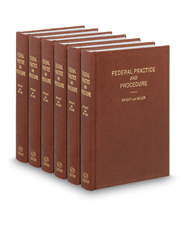 Federal practice and procedure.
by
Call Number: KF8840 .W68; available on WestlawPublication Date: 1969- (kept current with pocket and pamphlet supplements, cumulative supplement service, and revised volumes)Comprehensive and authoritative coverage of all aspects of federal civil, criminal and appellate procedure, including rules of civil, criminal, and appellate procedure, rules of evidence, the federal judicial system, jurisdiction of all federal courts, venue, removal of cases, res judicata, relation of state and federal courts, multidistrict litigation, and more. Provides extensive analysis of each rule as interpreted and applied by the federal courts and affected by related statutes and rules. Includes official forms adopted with the rules. Contains numerous tables and couples key words, ideas, and legal concepts to index and cited decisions, statutes, and other relevant materials.
Federal practice and procedure.
by
Call Number: KF8840 .W68; available on WestlawPublication Date: 1969- (kept current with pocket and pamphlet supplements, cumulative supplement service, and revised volumes)Comprehensive and authoritative coverage of all aspects of federal civil, criminal and appellate procedure, including rules of civil, criminal, and appellate procedure, rules of evidence, the federal judicial system, jurisdiction of all federal courts, venue, removal of cases, res judicata, relation of state and federal courts, multidistrict litigation, and more. Provides extensive analysis of each rule as interpreted and applied by the federal courts and affected by related statutes and rules. Includes official forms adopted with the rules. Contains numerous tables and couples key words, ideas, and legal concepts to index and cited decisions, statutes, and other relevant materials. -
 Moore's Federal practice: a treatise on the Federal rules of civil procedure,
by
Call Number: Available on LexisPublication Date: 1997-From its initial publication, Moore's instantly became, and remains today, the standard reference work on federal court procedure and has been cited thousands of times in federal court decisions. This latest edition represents a complete overhaul of the classic work, authored by over 50 distinguished federal judges, law professors, and practitioners, including many who, like Professor Moore, have been directly involved in the federal rulemaking process. Moore's 34 volumes include the full text of the federal rules along with extensive commentary and analysis of the rules and cases interpreting the rules.
Moore's Federal practice: a treatise on the Federal rules of civil procedure,
by
Call Number: Available on LexisPublication Date: 1997-From its initial publication, Moore's instantly became, and remains today, the standard reference work on federal court procedure and has been cited thousands of times in federal court decisions. This latest edition represents a complete overhaul of the classic work, authored by over 50 distinguished federal judges, law professors, and practitioners, including many who, like Professor Moore, have been directly involved in the federal rulemaking process. Moore's 34 volumes include the full text of the federal rules along with extensive commentary and analysis of the rules and cases interpreting the rules. -
 The Wagstaffe Group Practice Guide: Federal Civil Procedure Before Trial
by
Call Number: Available on LexisThis practice guide will help students: break down complex procedural issues quickly and easily, with spot-on insights from one of the leading litigators in the field; discover timesaving tools and step-by-step practical guidance through comprehensive checklists, practice tips and case examples; watch groundbreaking video content—over 150+ dynamic videos, each 2 – 5 minutes long, featuring expert tips, enhanced guidance and more.
The Wagstaffe Group Practice Guide: Federal Civil Procedure Before Trial
by
Call Number: Available on LexisThis practice guide will help students: break down complex procedural issues quickly and easily, with spot-on insights from one of the leading litigators in the field; discover timesaving tools and step-by-step practical guidance through comprehensive checklists, practice tips and case examples; watch groundbreaking video content—over 150+ dynamic videos, each 2 – 5 minutes long, featuring expert tips, enhanced guidance and more.
Commercial Law
Commercial Law
-
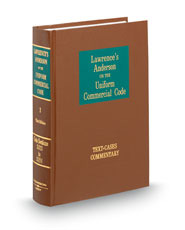 Anderson on the Uniform commercial code
by
Call Number: KF879.514 .A53; available on WestlawPublication Date: 1981- (kept current by pocket parts and revised volumes)Lawrence's Anderson on the Uniform Commercial Code provides article-by-article analysis of the UCC. It also covers: the Uniform Computer Information Transactions Act, the Uniform Electronic Transactions Act, he Electronic Signatures in Global and National Commerce Act
Anderson on the Uniform commercial code
by
Call Number: KF879.514 .A53; available on WestlawPublication Date: 1981- (kept current by pocket parts and revised volumes)Lawrence's Anderson on the Uniform Commercial Code provides article-by-article analysis of the UCC. It also covers: the Uniform Computer Information Transactions Act, the Uniform Electronic Transactions Act, he Electronic Signatures in Global and National Commerce Act -
 Uniform commercial code (hornbook series)
by
Call Number: KF889 .W45xISBN: 0314917667Publication Date: 2010- (Kept up to date by pocket parts)The book will give students a rigorous introduction to the UCC without burdening them with needless citations. The new edition deals not only with the 1999 revisions to Article 9 but also with the recent revisions to Article 1. Of course, this edition also addresses the earlier revisions to Articles 5, 3 and 4. It has limited coverage of the failed attempt to revise Article 2.
Uniform commercial code (hornbook series)
by
Call Number: KF889 .W45xISBN: 0314917667Publication Date: 2010- (Kept up to date by pocket parts)The book will give students a rigorous introduction to the UCC without burdening them with needless citations. The new edition deals not only with the 1999 revisions to Article 9 but also with the recent revisions to Article 1. Of course, this edition also addresses the earlier revisions to Articles 5, 3 and 4. It has limited coverage of the failed attempt to revise Article 2. -
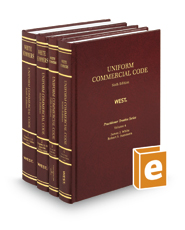 Uniform Commercial Code (practitioner treatise series)
by
Call Number: KF889 .W45xISBN: 9780314908551Publication Date: 2010- (kept current with pocket parts)White and Summers' Uniform Commercial Code, 5th and 6th provides practice-oriented insight and benefits both specialists and general practitioners. You'll find accurate and reliable analysis of the Uniform Commercial Code, practical understanding to apply the Code appropriately, thoughtful resolution of issues of Code interpretation, skillful deployment of the various non-textual Code resources relevant to such issues (including the Official Comments and prior Code drafts), informed policy analysis, systematic discussion of each topic, and a careful integration of the developing caselaw into text as well as footnotes.
Uniform Commercial Code (practitioner treatise series)
by
Call Number: KF889 .W45xISBN: 9780314908551Publication Date: 2010- (kept current with pocket parts)White and Summers' Uniform Commercial Code, 5th and 6th provides practice-oriented insight and benefits both specialists and general practitioners. You'll find accurate and reliable analysis of the Uniform Commercial Code, practical understanding to apply the Code appropriately, thoughtful resolution of issues of Code interpretation, skillful deployment of the various non-textual Code resources relevant to such issues (including the Official Comments and prior Code drafts), informed policy analysis, systematic discussion of each topic, and a careful integration of the developing caselaw into text as well as footnotes.

Constitutional Law
Constitutional Law
-
 American Constitutional Law
by
Call Number: KF4550 .T785ISBN: 1566627141Publication Date: 2000-This textbook focuses on the Constitution's provisions for government structure and on how constitutional structure helps guarantee protection of substantive rights and liberties. It promises to be an indispensable resource for teachers, students, practicing lawyers and judges. This preeminent treatise provides a wealth of original, insightful, and influential analysis of constitutional law doctrine and policy.Professor Tribe's central concern is the Constitution itself, not the Supreme Court as an institution. While addressing relevant issues of institutional capacities and roles, he does not stop at discussing the Court as the right or wrong forum to review a particular issue and render judgment; the more crucial question is whether the judgment itself was right or wrong as an element in the living development of constitutional justice.
American Constitutional Law
by
Call Number: KF4550 .T785ISBN: 1566627141Publication Date: 2000-This textbook focuses on the Constitution's provisions for government structure and on how constitutional structure helps guarantee protection of substantive rights and liberties. It promises to be an indispensable resource for teachers, students, practicing lawyers and judges. This preeminent treatise provides a wealth of original, insightful, and influential analysis of constitutional law doctrine and policy.Professor Tribe's central concern is the Constitution itself, not the Supreme Court as an institution. While addressing relevant issues of institutional capacities and roles, he does not stop at discussing the Court as the right or wrong forum to review a particular issue and render judgment; the more crucial question is whether the judgment itself was right or wrong as an element in the living development of constitutional justice. -
 The American State Constitutional Tradition
by
Call Number: KF4541 .D56ISBN: 9780700616893Publication Date: 2009For too long, the American constitutional tradition has been defined solely by the U.S. Constitution drafted in 1787. Yet constitutional debates at the state level open a window on how Americans, in different places and at different times, have chosen to govern themselves. From New Hampshire in 1776 to Louisiana in 1992, state constitutional conventions have served not only as instruments of democracy but also as forums for revising federal principles and institutions. In The American State Constitutional Tradition, John Dinan shows that state constitutions are much more than mere echoes of the federal document. The first comprehensive study of all 114 state constitutional conventions for which there are recorded debates, his book shows that state constitutional debates in many ways better reflect the accumulated wisdom of American constitution-makers than do the more traditional studies of the federal constitution. Wielding extraordinary command over a mass of historical detail, Dinan clarifies the alternatives considered by state constitution makers and the reasons for the adoption or rejection of various governing principles and institutions. Among other things, he shows that the states are nearly universal in their rejection of the rigid federal model of the constitutional amendment process, favoring more flexible procedures for constitutional change; they often grant citizens greater direct participation in law-making; they have debated and at times rejected the value of bicameralism; and they have altered the veto powers of both the executive and judicial branches. Dinan also shows that, while the Founders favored a minimalist design and focused exclusively on protecting individuals from government action, state constitution makers have often adopted more detailed constitutions, sometimes specifying positive rights that depend on government action for their enforcement. Moreover, unlike the federal constitution, state constitutions often contain provisions dedicated to the formation of citizen character, ranging from compulsory schooling to the regulation of gambling or liquor. By integrating state constitution making with the federal constitutional tradition, this path-breaking work widens and deepens our understanding of the principles by which we've chosen to govern ourselves.
The American State Constitutional Tradition
by
Call Number: KF4541 .D56ISBN: 9780700616893Publication Date: 2009For too long, the American constitutional tradition has been defined solely by the U.S. Constitution drafted in 1787. Yet constitutional debates at the state level open a window on how Americans, in different places and at different times, have chosen to govern themselves. From New Hampshire in 1776 to Louisiana in 1992, state constitutional conventions have served not only as instruments of democracy but also as forums for revising federal principles and institutions. In The American State Constitutional Tradition, John Dinan shows that state constitutions are much more than mere echoes of the federal document. The first comprehensive study of all 114 state constitutional conventions for which there are recorded debates, his book shows that state constitutional debates in many ways better reflect the accumulated wisdom of American constitution-makers than do the more traditional studies of the federal constitution. Wielding extraordinary command over a mass of historical detail, Dinan clarifies the alternatives considered by state constitution makers and the reasons for the adoption or rejection of various governing principles and institutions. Among other things, he shows that the states are nearly universal in their rejection of the rigid federal model of the constitutional amendment process, favoring more flexible procedures for constitutional change; they often grant citizens greater direct participation in law-making; they have debated and at times rejected the value of bicameralism; and they have altered the veto powers of both the executive and judicial branches. Dinan also shows that, while the Founders favored a minimalist design and focused exclusively on protecting individuals from government action, state constitution makers have often adopted more detailed constitutions, sometimes specifying positive rights that depend on government action for their enforcement. Moreover, unlike the federal constitution, state constitutions often contain provisions dedicated to the formation of citizen character, ranging from compulsory schooling to the regulation of gambling or liquor. By integrating state constitution making with the federal constitutional tradition, this path-breaking work widens and deepens our understanding of the principles by which we've chosen to govern ourselves. -
 Constitutional Law (hornbook series)
by
Call Number: KF4550 .N6; available in WestlawISBN: 9780314195999Publication Date: 2009Authoritative coverage examines the constitutional issues that are studied and litigated today. This text thoroughly analyzes and discusses the origins of judicial review and federal jurisdiction, the sources of national authority, the growth of federal commerce and fiscal powers, and the limits on state laws that burden interstate commerce. This book then explores and analyzes individual liberties and due process, including equal protection, freedom of speech and religion, federal powers to enforce the Bill of Rights, and limitations on the jurisdiction of federal courts. Finally, this one-volume treatise explores the separation of powers including the restrictions on the foreign affairs power and the recent cases on the war on terror. This book (and the 6-volume treatise by the same authors) has been cited by state and federal courts at all levels, from trial court to the U.S. Supreme Court, over 1,000 times.
Constitutional Law (hornbook series)
by
Call Number: KF4550 .N6; available in WestlawISBN: 9780314195999Publication Date: 2009Authoritative coverage examines the constitutional issues that are studied and litigated today. This text thoroughly analyzes and discusses the origins of judicial review and federal jurisdiction, the sources of national authority, the growth of federal commerce and fiscal powers, and the limits on state laws that burden interstate commerce. This book then explores and analyzes individual liberties and due process, including equal protection, freedom of speech and religion, federal powers to enforce the Bill of Rights, and limitations on the jurisdiction of federal courts. Finally, this one-volume treatise explores the separation of powers including the restrictions on the foreign affairs power and the recent cases on the war on terror. This book (and the 6-volume treatise by the same authors) has been cited by state and federal courts at all levels, from trial court to the U.S. Supreme Court, over 1,000 times. -
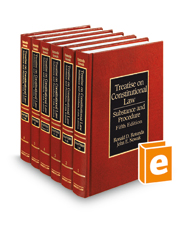 Treatise on constitutional law: substance and procedure
by
Call Number: KF4550 .R63; available on WestlawPublication Date: 2012- (kept current with pocket parts)Nowak and Rotunda's Treatise on Constitutional Law: Substance and Procedure provides scholars, practitioners, judges, and officials with an up-to-date analysis and synthesis of federal constitutional law. Focus is primarily on the Supreme Court and incorporates the political, historical, and economic background of court decisions.
Treatise on constitutional law: substance and procedure
by
Call Number: KF4550 .R63; available on WestlawPublication Date: 2012- (kept current with pocket parts)Nowak and Rotunda's Treatise on Constitutional Law: Substance and Procedure provides scholars, practitioners, judges, and officials with an up-to-date analysis and synthesis of federal constitutional law. Focus is primarily on the Supreme Court and incorporates the political, historical, and economic background of court decisions.
The text analyzes constitutional questions in terms of precedent, political science theory, economics, and American history, making the leading cases understandable concerning both their overall significance and the precise legal rules they establish.

Contracts
Contracts
-
 Contracts
by
Call Number: KF801 .C26; available on WestlawISBN: 9780314287700Publication Date: 2014Contents: Introduction -- Offer and acceptance -- Parol evidence and interpretation -- Consideration -- Informal contracts without consideration or injurious reliance -- Promissory estoppel as a substitute for consideration and much else -- Contracts under seal -- Capacity of parties -- Avoidance or reformation for misconduct or mistake -- Reserved for future use -- Conditions, performance and breach -- Anticipatory breach and prospective non-performance -- Impracticability and frustration -- Damages -- Restitution as a remedy for breach -- Specific performance and injunctions -- Third party beneficiaries -- Assignment and delegation -- Statute of frauds -- Joint and several contracts -- Discharge of contracts -- Illegal bargains.
Contracts
by
Call Number: KF801 .C26; available on WestlawISBN: 9780314287700Publication Date: 2014Contents: Introduction -- Offer and acceptance -- Parol evidence and interpretation -- Consideration -- Informal contracts without consideration or injurious reliance -- Promissory estoppel as a substitute for consideration and much else -- Contracts under seal -- Capacity of parties -- Avoidance or reformation for misconduct or mistake -- Reserved for future use -- Conditions, performance and breach -- Anticipatory breach and prospective non-performance -- Impracticability and frustration -- Damages -- Restitution as a remedy for breach -- Specific performance and injunctions -- Third party beneficiaries -- Assignment and delegation -- Statute of frauds -- Joint and several contracts -- Discharge of contracts -- Illegal bargains. -
 Corbin on Contracts
by
Call Number: KF801 .C65 1993; available on LexisISBN: 9780314228154Publication Date: 1993- (kept current with pocket parts)The 15-volume Corbin on Contracts is one of the most cited and influential treatises in print. Providing an exhaustive analysis of all the rules of contract law, including all exceptions and variations, Corbin on Contracts can help you prevent disputes and keep your clients out of court. Cited in the opinions of federal and state courts literally thousands of times, this exhaustive exposition of all the working rules of contract law has for more than half a century helped lawyers understand what the rules of contract mean and how they can be used in daily practice.
Corbin on Contracts
by
Call Number: KF801 .C65 1993; available on LexisISBN: 9780314228154Publication Date: 1993- (kept current with pocket parts)The 15-volume Corbin on Contracts is one of the most cited and influential treatises in print. Providing an exhaustive analysis of all the rules of contract law, including all exceptions and variations, Corbin on Contracts can help you prevent disputes and keep your clients out of court. Cited in the opinions of federal and state courts literally thousands of times, this exhaustive exposition of all the working rules of contract law has for more than half a century helped lawyers understand what the rules of contract mean and how they can be used in daily practice.
Publication of the Revised Edition was directed by renowned contracts expert Professor Joseph M. Perillo. In addition to the periodic issuance of replacement volumes, the set is updated twice each year with cumulative stand-alone and pocket-part supplements prepared by noted legal scholar Dr. John E. Murray, Jr., Chancellor and Professor of Law, Duquesne University. -
 Farnsworth on Contracts
by
Call Number: KF801 .F367ISBN: 9780735541429Publication Date: 2004- (kept current with supplements)Bring the expertise of America's foremost authority on contracts into your practice with this comprehensive three-volume set. Farnsworth on Contracts, Third Edition is where doctrine meets practice. Busy practitioners count on Farnsworth's proven ability to identify the essentials and omit extraneous material. His comprehensive coverage of the full range of contract law answers questions in hundreds of important areas, including: Good faith and fair dealing Precontractual liability Agreements to negotiate Vienna Convention on International Sales Contracts UNIDROIT principles Constitututional issues Settlement of disputed claims by check Options and rights of first refusal Employee handbooks Covenants not to compete Self-help measures Farnsworth illustrates how contemporary contract law has been shaped by both the Restatement (Second) of Contracts -- for which he served as Reporter -- and the Uniform Commercial Code. Easy access to specifics, new cases, new drafting tips, new references, and timesaving features like cross-referenced cases and marginal headings make this three-volume set a valuable resource for contracts research and practice, including litigation and arbitration. Farnsworth on Contracts, Third Edition is the most authoritative contracts treatise available.
Farnsworth on Contracts
by
Call Number: KF801 .F367ISBN: 9780735541429Publication Date: 2004- (kept current with supplements)Bring the expertise of America's foremost authority on contracts into your practice with this comprehensive three-volume set. Farnsworth on Contracts, Third Edition is where doctrine meets practice. Busy practitioners count on Farnsworth's proven ability to identify the essentials and omit extraneous material. His comprehensive coverage of the full range of contract law answers questions in hundreds of important areas, including: Good faith and fair dealing Precontractual liability Agreements to negotiate Vienna Convention on International Sales Contracts UNIDROIT principles Constitututional issues Settlement of disputed claims by check Options and rights of first refusal Employee handbooks Covenants not to compete Self-help measures Farnsworth illustrates how contemporary contract law has been shaped by both the Restatement (Second) of Contracts -- for which he served as Reporter -- and the Uniform Commercial Code. Easy access to specifics, new cases, new drafting tips, new references, and timesaving features like cross-referenced cases and marginal headings make this three-volume set a valuable resource for contracts research and practice, including litigation and arbitration. Farnsworth on Contracts, Third Edition is the most authoritative contracts treatise available. -
 Restatement of the Law Second, Contracts
by
Call Number: KF801 .R47; available on Lexis and WestlawPublication Date: 1981- (kept current with pocket parts)This work is the quintessential guide to the modern common law of contracts. It covers fundamental principles, providing a complete, coherent overview of contract law. Relied on and adopted by courts nationwide, this authoritative work is one of ALI’s most frequently cited publications.
Restatement of the Law Second, Contracts
by
Call Number: KF801 .R47; available on Lexis and WestlawPublication Date: 1981- (kept current with pocket parts)This work is the quintessential guide to the modern common law of contracts. It covers fundamental principles, providing a complete, coherent overview of contract law. Relied on and adopted by courts nationwide, this authoritative work is one of ALI’s most frequently cited publications.
Volume 1 covers the meaning of terms; formation of contracts-parties and capacity; formation of contracts-mutual assent; formation of contracts-consideration; the Statute of Frauds; mistake; and misrepresentation, duress, and undue influence.
Volume 2 includes unenforceability on grounds of public policy; the scope of contractual obligations; performance and non-performance; impracticability of performance and frustration of purpose; discharge by assent of alteration; joint and several promisors and promisees; and contract beneficiaries.
Volume 3 deals with assignment and delegation and remedies. -
A Treatise on the Law of Contracts byCall Number: KF801 .L67; available on WestlawPublication Date: 1990- (kept current with pocket parts)Williston on Contracts covers and analyzes every aspect of contract law, including historical underpinnings, majority and minority views, and current trends. It traces contract law from its common-law roots in English cases and shows how it has evolved to meet contemporary concerns. Topics include: contract formation, agreements, illegal agreements, statute of frauds, interpretations, conditions, excuses for nonperformance, and more. Also includes detailed examination of contracts such as employment and labor, arbitration, property sales, insurance, and other types of contracts, as well as cumulative tables, a correlation table, and a table of cases.

Corporations and Non-profit Corporations
Corporations
-
 Corporation Law
by
Call Number: KF1414 .G48x; available on WestlawISBN: 9780314159793Publication Date: 2010- (kept current with pocket parts)This Hornbook clarifies rather than simply recites corporations law, while paying attention to correcting common misconceptions held among students about the subject. Also appropriate for courts and commentators seeking the appropriate resolution of issues of corporations law. This book is written in a "user-friendly" style, with citations kept to a minimum. The second edition incorporates the major developments in corporate law in the decade since the first edition was published.
Corporation Law
by
Call Number: KF1414 .G48x; available on WestlawISBN: 9780314159793Publication Date: 2010- (kept current with pocket parts)This Hornbook clarifies rather than simply recites corporations law, while paying attention to correcting common misconceptions held among students about the subject. Also appropriate for courts and commentators seeking the appropriate resolution of issues of corporations law. This book is written in a "user-friendly" style, with citations kept to a minimum. The second edition incorporates the major developments in corporate law in the decade since the first edition was published. -
 Fletcher cyclopedia of the law of corporations
Call Number: Available on WestlawRegarded by attorneys and judges as the authoritative treatise on national corporation law for nearly a century, this multi-volume set provides comprehensive coverage of state and federal corporate law. It analyzes the entire range of legal issues facing a corporation during the its life cycle and includes references to relevant federal and state case law and statutes. The information is arranged in a variety of ways to help pinpoint the exact subject matter being researched. It also includes cross-references to Fletcher Corporation Forms Annotated.
Fletcher cyclopedia of the law of corporations
Call Number: Available on WestlawRegarded by attorneys and judges as the authoritative treatise on national corporation law for nearly a century, this multi-volume set provides comprehensive coverage of state and federal corporate law. It analyzes the entire range of legal issues facing a corporation during the its life cycle and includes references to relevant federal and state case law and statutes. The information is arranged in a variety of ways to help pinpoint the exact subject matter being researched. It also includes cross-references to Fletcher Corporation Forms Annotated.

Non-profit corporations
-
 The Law of Tax-Exempt Organizations
by
Call Number: KF6449 .H6ISBN: 9781118873694Publication Date: 2015- (kept current with supplements)The authoritative reference for nonprofit law, by leading expert Bruce R. Hopkins The Law of Tax-Exempt Organizations 11th edition details the complex set of statutes, regulations that govern this diverse category of organizations, IRS rulings, and court opinions. This new edition includes the most up-to-date coverage of subjects such as: nonprofit governance, and new rules for donor advised funds and supporting organizations, updates on unrelated business activities. Discussion of subjects such as the private inurement doctrine and private benefit doctrine have been expanded in light of recent IRS ruling activity. Written in plain English and supplemented annually, this book helps the lawyers and managers of tax-exempt organizations stay up to date on relevant law developments so they can make more informed decisions about their organization's actions and future direction. This eleventh edition is an important revision, with significant updates and vital information you need to know. Get up to date on the latest regulations and court opinions See how recent IRS rulings impact many aspects of tax-exempt organizations law Learn how the health care shift has generated new guidelines Read new law concerning legislative and political activities, intermediate sanctions, and more Written by one of the country's leading authorities on the law surrounding tax-exempt organizations, this comprehensive and authoritative reference allows you to learn the particulars of the subject matter or get a quick refresher regarding specific rules of interest. For newcomers and experienced practitioners alike, The Law of Tax-Exempt Organizations 11th edition provides a single-volume resource for the latest, most up-to-date information aspects of the law.
The Law of Tax-Exempt Organizations
by
Call Number: KF6449 .H6ISBN: 9781118873694Publication Date: 2015- (kept current with supplements)The authoritative reference for nonprofit law, by leading expert Bruce R. Hopkins The Law of Tax-Exempt Organizations 11th edition details the complex set of statutes, regulations that govern this diverse category of organizations, IRS rulings, and court opinions. This new edition includes the most up-to-date coverage of subjects such as: nonprofit governance, and new rules for donor advised funds and supporting organizations, updates on unrelated business activities. Discussion of subjects such as the private inurement doctrine and private benefit doctrine have been expanded in light of recent IRS ruling activity. Written in plain English and supplemented annually, this book helps the lawyers and managers of tax-exempt organizations stay up to date on relevant law developments so they can make more informed decisions about their organization's actions and future direction. This eleventh edition is an important revision, with significant updates and vital information you need to know. Get up to date on the latest regulations and court opinions See how recent IRS rulings impact many aspects of tax-exempt organizations law Learn how the health care shift has generated new guidelines Read new law concerning legislative and political activities, intermediate sanctions, and more Written by one of the country's leading authorities on the law surrounding tax-exempt organizations, this comprehensive and authoritative reference allows you to learn the particulars of the subject matter or get a quick refresher regarding specific rules of interest. For newcomers and experienced practitioners alike, The Law of Tax-Exempt Organizations 11th edition provides a single-volume resource for the latest, most up-to-date information aspects of the law.

Criminal Law & Procedure
Criminal Law & Procedure
-
 Constitutional Rights of the Accused
by
Call Number: Available on WestlawPublication Date: 1996-Constitutional Rights of the Accused analyzes federal constitutional rights, focusing on frequently litigated topics such as arrest, search and seizure, and confessions. Organized to follow the course of any criminal action, it provides insight on many topics.
Constitutional Rights of the Accused
by
Call Number: Available on WestlawPublication Date: 1996-Constitutional Rights of the Accused analyzes federal constitutional rights, focusing on frequently litigated topics such as arrest, search and seizure, and confessions. Organized to follow the course of any criminal action, it provides insight on many topics. -
 Criminal procedure
by
Call Number: KF9619 .L34; available on WestlawPublication Date: 2015- (kept current with pocket parts)Focusing on the pattern used by most states, the authors of Criminal Procedure provide step-by-step guidance through the typical state court criminal justice system. They explore every facet of criminal procedure from pre-arrest to pretrial, trial, postconviction, and appellate proceedings. Footnote documentation citing pivotal Supreme Court decisions is included.
Criminal procedure
by
Call Number: KF9619 .L34; available on WestlawPublication Date: 2015- (kept current with pocket parts)Focusing on the pattern used by most states, the authors of Criminal Procedure provide step-by-step guidance through the typical state court criminal justice system. They explore every facet of criminal procedure from pre-arrest to pretrial, trial, postconviction, and appellate proceedings. Footnote documentation citing pivotal Supreme Court decisions is included. -
 Orfield's Criminal procedure under the federal rules
by
Call Number: Available on WestlawPublication Date: 1999-Orfield's Criminal Procedure Under the Federal Rules provides a detailed treatment of the Federal Rules of Criminal Procedure and their constitutional underpinnings. Scholarly in its approach yet practical in its application, this multiple-volume set covers: appeal, arraignment, history of federal criminal procedure since 1789, indictment and information, preliminary proceedings, each rule's scope, special proceedings.
Orfield's Criminal procedure under the federal rules
by
Call Number: Available on WestlawPublication Date: 1999-Orfield's Criminal Procedure Under the Federal Rules provides a detailed treatment of the Federal Rules of Criminal Procedure and their constitutional underpinnings. Scholarly in its approach yet practical in its application, this multiple-volume set covers: appeal, arraignment, history of federal criminal procedure since 1789, indictment and information, preliminary proceedings, each rule's scope, special proceedings. -
 Substantive Criminal Law
by
Call Number: KF9219 .L386; available on WestlawISBN: 9780314108029Publication Date: 2003- (kept current with pocket parts)Substantive Criminal Law analyzes the law in terms of caselaw and statutory law via the Model Penal Code. The text focuses on the ways specific crimes and general principles of criminal law are defined by state statutes and interpreted by the courts.
Substantive Criminal Law
by
Call Number: KF9219 .L386; available on WestlawISBN: 9780314108029Publication Date: 2003- (kept current with pocket parts)Substantive Criminal Law analyzes the law in terms of caselaw and statutory law via the Model Penal Code. The text focuses on the ways specific crimes and general principles of criminal law are defined by state statutes and interpreted by the courts.
Extensive discussion of the Model Penal Code provides accurate assessment of the statutory particulars of each state, as well as their probable ramifications. -
 Wharton's criminal evidence.
by
Call Number: KF9660 .B47; available on WestlawPublication Date: 1997- (kept current with pocket parts)Wharton's Criminal Evidence thoroughly analyzes applicable Federal Rules of Evidence and cases interpreting the rules. Expert authors compare and contrast corresponding evidentiary rules, statutes, and individual state cases. All evidence and admissibility principles are treated specifically as they apply to criminal cases. This title contains expert guidance for both defense and prosecution on handling witnesses, impeachment rules, lay witness opinion, expert testimony, and real and demonstrative evidence.
Wharton's criminal evidence.
by
Call Number: KF9660 .B47; available on WestlawPublication Date: 1997- (kept current with pocket parts)Wharton's Criminal Evidence thoroughly analyzes applicable Federal Rules of Evidence and cases interpreting the rules. Expert authors compare and contrast corresponding evidentiary rules, statutes, and individual state cases. All evidence and admissibility principles are treated specifically as they apply to criminal cases. This title contains expert guidance for both defense and prosecution on handling witnesses, impeachment rules, lay witness opinion, expert testimony, and real and demonstrative evidence.
It discusses admissibility rules, including relevance, hearsay, privileged communications, authentication and identification, best evidence issues, and burdens of proof. The authors include major Supreme Court criminal evidence decisions. -
 Wharton's criminal law
by
Call Number: Available on WestlawPublication Date: 1993-The multivolume Wharton's Criminal Law examines and analyzes the phases of substantive criminal law in state and federal jurisdictions. This set includes: specific definitions of dozens of existing and emerging types of crimes; discussion of the types of defenses; structural analysis of each basic principle of criminal law, including its roots, developments, and present status; in-depth discussion of the American Law Institute's Model Penal Code.
Wharton's criminal law
by
Call Number: Available on WestlawPublication Date: 1993-The multivolume Wharton's Criminal Law examines and analyzes the phases of substantive criminal law in state and federal jurisdictions. This set includes: specific definitions of dozens of existing and emerging types of crimes; discussion of the types of defenses; structural analysis of each basic principle of criminal law, including its roots, developments, and present status; in-depth discussion of the American Law Institute's Model Penal Code. -
 Wharton's criminal procedure
by
Call Number: KF9619 .T672x; available on WestlawPublication Date: 2002- (loose-leaf)Use this multiple-volume set as a first-search reference for handling criminal cases. Expert resource provides essential coverage of the law by thoroughly analyzing common-law development and criminal procedure. Text traces statutory and judicial changes, as well as modifications, in common law. Subjects include criminal and juvenile court, venue, arrest, extradition, preliminary hearings, search and seizure, and grand juries. Addresses indictment, bail, arraignment and pleas, pre-trial motions and objections, and discovery. Discusses self-incrimination, trial, opening statements, and closing arguments. Complete post-trial coverage, including charge to jury, jury separation and deliberation, verdict, motions, sentence, punishment, appeal, and post-conviction remedies.
Wharton's criminal procedure
by
Call Number: KF9619 .T672x; available on WestlawPublication Date: 2002- (loose-leaf)Use this multiple-volume set as a first-search reference for handling criminal cases. Expert resource provides essential coverage of the law by thoroughly analyzing common-law development and criminal procedure. Text traces statutory and judicial changes, as well as modifications, in common law. Subjects include criminal and juvenile court, venue, arrest, extradition, preliminary hearings, search and seizure, and grand juries. Addresses indictment, bail, arraignment and pleas, pre-trial motions and objections, and discovery. Discusses self-incrimination, trial, opening statements, and closing arguments. Complete post-trial coverage, including charge to jury, jury separation and deliberation, verdict, motions, sentence, punishment, appeal, and post-conviction remedies.
E-commerce
E-Commerce Law
-
 Law of Electronic Commerce
by
Call Number: KF390.B84 W56xISBN: 0735516480Publication Date: 2000- (loose-leaf)This cutting edge legal resource provides practice pointers and in-depth, up-to-the-minute analysis of electronic contracting, electronic payments and lending, intellectual property rights and rights in data, privacy and collections of data, E-business regulation, including antitrust, trade practices, securities and banking, taxation of electronic commerce, security, liability, and much more. By Jane Kaufman Winn and Benjamin Wright. The volume of trade done through electronic media continues to skyrocket, and the law evolves at a staggering rate. To keep pace with all the new cases, statutes, proposals, commentaries, and model laws, there is no better resource than the Law of Electronic Commerce - your guide to the implications of communications technology for commercial law and transactions. The Fourth Edition has been completely revised to reflect the explosive growth of the internet and the one-to-many network model that has replaced older forms of electronic commerce. You'll find practice pointers and in-depth, up-to-the-minute analysis of: Electronic contracting Electronic Payments and Lending Intellectual property rights and rights in data Privacy and collections of data E-business regulation, including antitrust, trade practices, securities and banking Taxation of electronic commerce Computer crime and computer security Electronic records in litigation, including authentication and the best evidence rule Employer liability and electronic communications in the workplace Developing a records management program Liability of service providers and much more
Law of Electronic Commerce
by
Call Number: KF390.B84 W56xISBN: 0735516480Publication Date: 2000- (loose-leaf)This cutting edge legal resource provides practice pointers and in-depth, up-to-the-minute analysis of electronic contracting, electronic payments and lending, intellectual property rights and rights in data, privacy and collections of data, E-business regulation, including antitrust, trade practices, securities and banking, taxation of electronic commerce, security, liability, and much more. By Jane Kaufman Winn and Benjamin Wright. The volume of trade done through electronic media continues to skyrocket, and the law evolves at a staggering rate. To keep pace with all the new cases, statutes, proposals, commentaries, and model laws, there is no better resource than the Law of Electronic Commerce - your guide to the implications of communications technology for commercial law and transactions. The Fourth Edition has been completely revised to reflect the explosive growth of the internet and the one-to-many network model that has replaced older forms of electronic commerce. You'll find practice pointers and in-depth, up-to-the-minute analysis of: Electronic contracting Electronic Payments and Lending Intellectual property rights and rights in data Privacy and collections of data E-business regulation, including antitrust, trade practices, securities and banking Taxation of electronic commerce Computer crime and computer security Electronic records in litigation, including authentication and the best evidence rule Employer liability and electronic communications in the workplace Developing a records management program Liability of service providers and much more

E-discovery
E-discovery
-
 Electronic discovery law and practice.
by
Call Number: Available on WestlawPublication Date: 2009-Electronic Discovery: Law and Practice, Second Edition offers detailed analysis and guidance on the legal aspects of electronic discovery never before collected in such a comprehensive guide. You’ll save time on research while benefiting from the knowledge and experience of the leading experts.
Electronic discovery law and practice.
by
Call Number: Available on WestlawPublication Date: 2009-Electronic Discovery: Law and Practice, Second Edition offers detailed analysis and guidance on the legal aspects of electronic discovery never before collected in such a comprehensive guide. You’ll save time on research while benefiting from the knowledge and experience of the leading experts.
Education Law
Education Law
-
 Education Law
by
Call Number: Law School KF4119 .G47ISBN: 9781933264226Publication Date: 2007The legal relationship between student and school is a fragile one. Almost every area of law affects education institutions in some manner. The rights of students, parents, and school employees are governed by constitutional provisions and by federal, state and local statutes. Contract law, tort law, constitutional law, civil rights law, sports law and disability combine to form the basis of education law. Education Law, Second Edition is your essential guide to creating standards for your school district and enforcing your legal rights in the classroom. You will be guided through the rights of teachers and other school employees, parents, and students through case studies of previous legal actions. The authors, Lois and Ralph Gerstein, analyze these legal issues from the points of view of students, parents, and school personnel, providing a well-rounded explanation of how local, state, and federal laws are interpreted in numerous and diverse education-related cases.
Education Law
by
Call Number: Law School KF4119 .G47ISBN: 9781933264226Publication Date: 2007The legal relationship between student and school is a fragile one. Almost every area of law affects education institutions in some manner. The rights of students, parents, and school employees are governed by constitutional provisions and by federal, state and local statutes. Contract law, tort law, constitutional law, civil rights law, sports law and disability combine to form the basis of education law. Education Law, Second Edition is your essential guide to creating standards for your school district and enforcing your legal rights in the classroom. You will be guided through the rights of teachers and other school employees, parents, and students through case studies of previous legal actions. The authors, Lois and Ralph Gerstein, analyze these legal issues from the points of view of students, parents, and school personnel, providing a well-rounded explanation of how local, state, and federal laws are interpreted in numerous and diverse education-related cases. -
 Education law
by
Call Number: Gutman Reference KF4119 .R36 1984-; available on Lexis.Publication Date: 2002- (loose-leaf)Education Law - an indispensable reference for attorneys who represent persons having a grievance against educational institutions,and attorneys representing such institutions. Authoritative analysis of federal and state statutes and cases affecting public and private educational institutions at all levels
Education law
by
Call Number: Gutman Reference KF4119 .R36 1984-; available on Lexis.Publication Date: 2002- (loose-leaf)Education Law - an indispensable reference for attorneys who represent persons having a grievance against educational institutions,and attorneys representing such institutions. Authoritative analysis of federal and state statutes and cases affecting public and private educational institutions at all levels
Includes such topics as: banning of books, school prayer, dealing with students afflicted with AIDS, tax-exempt status for parochial schools, funding accreditations, tort liability. Guidance on collective bargaining strategies, drafting codes of student conduct and conducting student searches. Selected forms, including contracts, model school policies, litigation forms, as well as checklists
Tables of state legislation concerning important issues facing educational institutions. -
 The Law of Higher Education
by
Call Number: KF4225 .K36ISBN: 9781118032015Publication Date: 2013The Law of Higher Education, Fifth Edition is an up-to-date and comprehensive reference, research source, and practical legal guide for college and university administrators, campus attorneys, legal counsel, and institutional researchers, addressing all the major legal issues and regulatory developments in higher education. In the increasingly litigious environment of higher education, William A. Kaplin and Barbara A. Lee's clear, cogent, and contextualized legal guide proves more and more indispensable every year. Over 3,000 new cases related to higher education have been decided since the publication of the previous edition, and scores of changes to higher education law are made each year. Every section of the fifth edition contains new material, including those related to: hate speech and free speech rights of faculty in public universities; sharing of research with international colleagues; intellectual property and peer-to-peer file sharing; student suicide; campus safety; police and administrators right to search students residence hall rooms; governmental support for religious institutions and religious autonomy rights of individual public institutions; collective bargaining and antidiscrimination laws; nondiscrimination and affirmative action in employment, admissions, and financial aid; Family and Medical Leave Act and workers compensation; FERPA (Family Educational Rights and Privacy Act).
The Law of Higher Education
by
Call Number: KF4225 .K36ISBN: 9781118032015Publication Date: 2013The Law of Higher Education, Fifth Edition is an up-to-date and comprehensive reference, research source, and practical legal guide for college and university administrators, campus attorneys, legal counsel, and institutional researchers, addressing all the major legal issues and regulatory developments in higher education. In the increasingly litigious environment of higher education, William A. Kaplin and Barbara A. Lee's clear, cogent, and contextualized legal guide proves more and more indispensable every year. Over 3,000 new cases related to higher education have been decided since the publication of the previous edition, and scores of changes to higher education law are made each year. Every section of the fifth edition contains new material, including those related to: hate speech and free speech rights of faculty in public universities; sharing of research with international colleagues; intellectual property and peer-to-peer file sharing; student suicide; campus safety; police and administrators right to search students residence hall rooms; governmental support for religious institutions and religious autonomy rights of individual public institutions; collective bargaining and antidiscrimination laws; nondiscrimination and affirmative action in employment, admissions, and financial aid; Family and Medical Leave Act and workers compensation; FERPA (Family Educational Rights and Privacy Act). -
 Special Education Law
by
Call Number: KF4209.3 .L38 2008ISBN: 0205479758Publication Date: 2008Clear, well organized presentation of IDEA and other pertinent federal laws, together with well organized discussion of relevant cases, help educators understand and apply their knowledge in concrete situations. The emphasis of this practical book is on increasing understanding at a conceptual level rather than rote memorization of detailed provisions of the IDEA and other laws. By understanding the law, educators will be better equipped to work with future amendments of IDEA and with new laws that may be enacted by Congress. They will also have an increased ability to apply statutory provisions to specific situations. Part I - Constitutional Framework: provides important background in understanding the authority that Congress has to enact laws that impact on education in the United States and the authority that the courts have to interpret laws. Includes discussion of the judicial system, the key provisions of the United States Constitution, due process, equal protection, the statutes of certain regulations, and a brief overview and comparison of the Individuals with Disabilities Education Act (IDEA), the Rehabilitation Act (RA), and the Americans with Disabilities Act (ADA). Part II - IDEA: covers background, basic language and coverage, duty to evaluate, FAPE, IEP, placement, related services, inclusions/least restrictive environment, private school, discipline, mediation, due process, and court proceedings. Sample forms are included to supplement discussion with concrete examples to aid understanding.Part III - RA and ADA covers RA/ADA basics, such as who is an individual with a disability, what entities are covered, enforcement provisions, and application to schools, universities, and employers.Part IV - Other Legal Issues: covers No Child Left Behind, FERPA, tort liability, and high stakes testing issues. At the end of each part there is a very basic question and answer section to assist the student in focusing on major points in each part.
Special Education Law
by
Call Number: KF4209.3 .L38 2008ISBN: 0205479758Publication Date: 2008Clear, well organized presentation of IDEA and other pertinent federal laws, together with well organized discussion of relevant cases, help educators understand and apply their knowledge in concrete situations. The emphasis of this practical book is on increasing understanding at a conceptual level rather than rote memorization of detailed provisions of the IDEA and other laws. By understanding the law, educators will be better equipped to work with future amendments of IDEA and with new laws that may be enacted by Congress. They will also have an increased ability to apply statutory provisions to specific situations. Part I - Constitutional Framework: provides important background in understanding the authority that Congress has to enact laws that impact on education in the United States and the authority that the courts have to interpret laws. Includes discussion of the judicial system, the key provisions of the United States Constitution, due process, equal protection, the statutes of certain regulations, and a brief overview and comparison of the Individuals with Disabilities Education Act (IDEA), the Rehabilitation Act (RA), and the Americans with Disabilities Act (ADA). Part II - IDEA: covers background, basic language and coverage, duty to evaluate, FAPE, IEP, placement, related services, inclusions/least restrictive environment, private school, discipline, mediation, due process, and court proceedings. Sample forms are included to supplement discussion with concrete examples to aid understanding.Part III - RA and ADA covers RA/ADA basics, such as who is an individual with a disability, what entities are covered, enforcement provisions, and application to schools, universities, and employers.Part IV - Other Legal Issues: covers No Child Left Behind, FERPA, tort liability, and high stakes testing issues. At the end of each part there is a very basic question and answer section to assist the student in focusing on major points in each part.


Eminent Domain & Takings
Eminent Domain & Takings
-
 Nichols on Eminent Domain
by
Call Number: Available on LexisPublication Date: 2000-Comprehensive and current, this definitive treatise on the law of eminent domain discusses the origin, characteristics, nature, and extent of the power of eminent domain; valuation and damages; preparation of claims and negotiations, and the passing of ownership and the nature of the title acquired.
Nichols on Eminent Domain
by
Call Number: Available on LexisPublication Date: 2000-Comprehensive and current, this definitive treatise on the law of eminent domain discusses the origin, characteristics, nature, and extent of the power of eminent domain; valuation and damages; preparation of claims and negotiations, and the passing of ownership and the nature of the title acquired. -
 Regulatory Takings
by
Call Number: KF5599 .E18; available on LexisISBN: 9781422476543Publication Date: 2009- (kept current with pocket parts)Regulatory Takings provides clear, yet trenchant analyses of the federal and state constitutional principles that arise when expanding land use regulations clash with the right of citizens to receive just compensation when their property is taken.
Regulatory Takings
by
Call Number: KF5599 .E18; available on LexisISBN: 9781422476543Publication Date: 2009- (kept current with pocket parts)Regulatory Takings provides clear, yet trenchant analyses of the federal and state constitutional principles that arise when expanding land use regulations clash with the right of citizens to receive just compensation when their property is taken.
Employment Law (see Labor & Employment Law)
Employment Law
Entertainment Law
Entertainment Law
-
 Entertainment law
by
Call Number: KF4290 .F74Publication Date: 2006- (kept current with pocket parts)Provides an in-depth discussion and analysis of recent entertainment case law, forms, and drafting guidance, Entertainment Law covers the entire spectrum of entertainment law issues, including: investment, distribution, talent representation, agreements, credits and billing, artistic control, defamation, privacy, publicity, copyright, moral rights, trademark, unfair competition, electronic rights.
Entertainment law
by
Call Number: KF4290 .F74Publication Date: 2006- (kept current with pocket parts)Provides an in-depth discussion and analysis of recent entertainment case law, forms, and drafting guidance, Entertainment Law covers the entire spectrum of entertainment law issues, including: investment, distribution, talent representation, agreements, credits and billing, artistic control, defamation, privacy, publicity, copyright, moral rights, trademark, unfair competition, electronic rights.
In this text, you will also find: analysis of recent cases, discussion of network and affiliate relations, tips about litigation involving celebrities, sample forms, checklists, a glossary of industry terms -
 Entertainment law: legal concepts and business practices
by
Call Number: KF4290 .S443xPublication Date: 2006- (loose-leaf)Offering a unique focus on situations that arise during litigation that involve celebrities, Entertainment Law: Legal Concepts and Business Practices is a comprehensive reference for entertainment attorneys. Specific citations to state and federal statutes, rules, and caselaw are included to assist in every phase of trial preparation through appeals.
Entertainment law: legal concepts and business practices
by
Call Number: KF4290 .S443xPublication Date: 2006- (loose-leaf)Offering a unique focus on situations that arise during litigation that involve celebrities, Entertainment Law: Legal Concepts and Business Practices is a comprehensive reference for entertainment attorneys. Specific citations to state and federal statutes, rules, and caselaw are included to assist in every phase of trial preparation through appeals. -
 Lindey on entertainment, publishing, and the arts: agreements and the law
by
Call Number: KF4290 .L56xPublication Date: 2004- (loose-leaf)Lindey on Entertainment, Publishing and the Arts is an unparalleled reference and practical resource for entertainment lawyers. A wealth of forms and agreements for transactions involving traditional and new media (music, film, sound recordings, television, photographs, software, and others) enable you to meet the challenges of a legally complex entertainment field. Updates address topics such as: fair use, duration of copyright, copyrighted works posted to Twitter, marks consisting of domain names, trade dress and functionality, unfair and false advertising, regulation of nonobscene offensive content, the Visual Artists Rights Act
Lindey on entertainment, publishing, and the arts: agreements and the law
by
Call Number: KF4290 .L56xPublication Date: 2004- (loose-leaf)Lindey on Entertainment, Publishing and the Arts is an unparalleled reference and practical resource for entertainment lawyers. A wealth of forms and agreements for transactions involving traditional and new media (music, film, sound recordings, television, photographs, software, and others) enable you to meet the challenges of a legally complex entertainment field. Updates address topics such as: fair use, duration of copyright, copyrighted works posted to Twitter, marks consisting of domain names, trade dress and functionality, unfair and false advertising, regulation of nonobscene offensive content, the Visual Artists Rights Act
The set includes citations to state and federal statutes, rules, and caselaw, and offers up-to-date analysis of legal developments in substantive areas of law, along with detailed discussion of significant cases involving: digital media and file sharing; false advertising; interaction between attribution, trademark law, and copyright law; music and sound recording sampling; digital downloads and performance rights.
Environmental Law
Environmental Law
-
 Environmental Law
by
Call Number: KF3775 .R59ISBN: 0314035761Publication Date: 1994- (kept current with pocket parts)This authoritative coverage of environmental law presents a broad perspective and a critical appraisal of recent developments. Dependable predictions for the future are listed as well. Text provides analyses of federal environmental statutes, regulations, and policies plus citations to court decisions explaining these laws.
Environmental Law
by
Call Number: KF3775 .R59ISBN: 0314035761Publication Date: 1994- (kept current with pocket parts)This authoritative coverage of environmental law presents a broad perspective and a critical appraisal of recent developments. Dependable predictions for the future are listed as well. Text provides analyses of federal environmental statutes, regulations, and policies plus citations to court decisions explaining these laws. -
 Treatise on Environmental Law
by
Call Number: Available on LexisISBN: 0820513237Publication Date: 2000-This seminal treatise examines the issues and analyzes US statutes and important case law in every area of environmental law. Topics covered include: air, water and noise pollution; solid waste; hazardous waste; toxic substances; radiation; the National Environmental Policy Act and the Little NEPA's of the states; environmental protection aspects of land use planning and controls; and international aspects of environmental protection under US law. The price quoted for the work, which is updated twice a year, covers one year's worth of service.
Treatise on Environmental Law
by
Call Number: Available on LexisISBN: 0820513237Publication Date: 2000-This seminal treatise examines the issues and analyzes US statutes and important case law in every area of environmental law. Topics covered include: air, water and noise pollution; solid waste; hazardous waste; toxic substances; radiation; the National Environmental Policy Act and the Little NEPA's of the states; environmental protection aspects of land use planning and controls; and international aspects of environmental protection under US law. The price quoted for the work, which is updated twice a year, covers one year's worth of service.
Evidence
Evidence
-
Evidence, 7th (Hornbook Series) by
Call Number: KF8935 .M292ISBN: 9780314290250Publication Date: 2014-This single-volume treatise is largely free of citations to authority, but retains the most notable footnotes. Topics covered include preparing and presenting evidence, cross-examination, and the procedure for admitting and excluding evidence. Discusses privilege against self-incrimination, privilege concerning improperly obtained evidence, scientific evidence, and demonstrative evidence. Reviews authentication, the hearsay rule, burdens of proof, and presumptions. Text also identifies current issues. -
Evidence in trials at common law byCall Number: KF8935 .W54xPublication Date: 1961- (kept current with supplements)
-
 Federal Rules of Evidence Manual
by
Call Number: KF8935 .S2; available on LexisISBN: 9781632844149Publication Date: 2015- (kept current with supplements)Cited widely by courts and consulted regularly by thousands of attorneys across the nation, the Federal Rules of Evidence Manual provides the following for each Rule: the complete, current text; a current explanation by experts on federal evidence rules; comprehensive descriptions of salient cases; and the relevant legislative history. Supplements are issued twice each year, to ensure that the Manual remains up to date.
Federal Rules of Evidence Manual
by
Call Number: KF8935 .S2; available on LexisISBN: 9781632844149Publication Date: 2015- (kept current with supplements)Cited widely by courts and consulted regularly by thousands of attorneys across the nation, the Federal Rules of Evidence Manual provides the following for each Rule: the complete, current text; a current explanation by experts on federal evidence rules; comprehensive descriptions of salient cases; and the relevant legislative history. Supplements are issued twice each year, to ensure that the Manual remains up to date. -
 McCormick on Evidence (practitioner treatise series)
by
Call Number: KF8935 .M29; also available on WestlawISBN: 9780314812520Publication Date: 2013- (kept current with pocket parts)Recognized as the foremost authority on evidence law today, McCormick on Evidence offers comprehensive and authoritative analysis of the rules and theory of evidence.
McCormick on Evidence (practitioner treatise series)
by
Call Number: KF8935 .M29; also available on WestlawISBN: 9780314812520Publication Date: 2013- (kept current with pocket parts)Recognized as the foremost authority on evidence law today, McCormick on Evidence offers comprehensive and authoritative analysis of the rules and theory of evidence.
When there are specific questions of evidence for which a jurisdiction has no precedent, this treatise provides both general theories that may be argued to suggest the answer and varying views from other jurisdictions. Like the Dean McCormick's original text, the Seventh Edition continues to provide a pragmatic approach to the law of evidence. -
 Modern Scientific Evidence (student edition)
by
Call Number: KF8961 .M625 2008xISBN: 0314184147Publication Date: 2008This book features the following salient topics: Admissibility of Scientific Evidence, A Functional Taxonomy of Expertise Ethical Standards of and Concerning Expert Witnesses; The Scientific Method; The Logic of Drawing Inferences From Empirical Evidences; Statistical Proof; Multiple Regression; Survey Research; Toxicology and Epidemiology.
Modern Scientific Evidence (student edition)
by
Call Number: KF8961 .M625 2008xISBN: 0314184147Publication Date: 2008This book features the following salient topics: Admissibility of Scientific Evidence, A Functional Taxonomy of Expertise Ethical Standards of and Concerning Expert Witnesses; The Scientific Method; The Logic of Drawing Inferences From Empirical Evidences; Statistical Proof; Multiple Regression; Survey Research; Toxicology and Epidemiology. -
 Modern scientific evidence : the law and science of expert testimony.
by
Call Number: KF8961 .M632; available on WestlawPublication Date: 2005- (annual)Modern Scientific Evidence: The Law and Science of Expert Testimony helps judges and lawyers assess the validity of an expert's scientific methodology, following the scientific evidence issues raised by the Daubert ruling. The text challenges the use of “generally accepted” scientific ideas when ruling on admissibility or managing expert witnesses in state and federal courts, and prepares trial attorneys to explain scientific concepts during admissibility arguments and confidently elicit or challenge expert testimony during trial.
Modern scientific evidence : the law and science of expert testimony.
by
Call Number: KF8961 .M632; available on WestlawPublication Date: 2005- (annual)Modern Scientific Evidence: The Law and Science of Expert Testimony helps judges and lawyers assess the validity of an expert's scientific methodology, following the scientific evidence issues raised by the Daubert ruling. The text challenges the use of “generally accepted” scientific ideas when ruling on admissibility or managing expert witnesses in state and federal courts, and prepares trial attorneys to explain scientific concepts during admissibility arguments and confidently elicit or challenge expert testimony during trial. -
 The New Wigmore: Evidentiary Privileges
by
Call Number: KF8958 .I49; available on WestlawISBN: 9780735593954Publication Date: 2009- (kept current with supplements)Evidentiary Privileges offers unique analysis of recent evidentiary problems including application of the attorney-client privilege to government agencies and corporate entities, and the difficulty of determining exactly who holds the privilege. In these two volumes, you’ll find also a practical framework for evaluating the existence or scope of new privileges.
The New Wigmore: Evidentiary Privileges
by
Call Number: KF8958 .I49; available on WestlawISBN: 9780735593954Publication Date: 2009- (kept current with supplements)Evidentiary Privileges offers unique analysis of recent evidentiary problems including application of the attorney-client privilege to government agencies and corporate entities, and the difficulty of determining exactly who holds the privilege. In these two volumes, you’ll find also a practical framework for evaluating the existence or scope of new privileges. -
The New Wigmore: expert evidence
by
Call Number: KF8961 .K39; available on WestlawISBN: 9780735593534Publication Date: 2010- (kept current with supplements)Expert Evidence provides in-depth coverage of the topics that lawyers and judges must know when dealing with expert testimony concerning medicine, engineering, psychology, economics, and forensic science, among other areas. It covers the topics common to all such testimony and focuses on scientific and statistical evidence, providing sophisticated and up-to-date explanations and analyses.
-
The New Wigmore: impeachment and rehabilitation
by
Call Number: KF8950 .P37; available on WestlawISBN: 9781454813286Publication Date: 2012- (kept current with supplements)Impeachment and Rehabilitation is a thorough review of all the rules governing impeachment of witnesses. It deals with impeachment with prior convictions, with prior bad acts, with inconsistent statements, with evidence of bias, and other evidence derogating credibility. Rules about limits on the use of extrinsic evidence to impeach are covered in detail.
The volume also contains a substantial section on the rules governing support and rehabilitation of witnesses. Numerous examples of successful cross-examination and unsuccessful cross-examinations are set forth in order to provide practical guidance to the practitioner. -
The New Wigmore: Selected rules of limited admissibility
by
Call Number: KF8935 .L46; available on WestlawISBN: 0735527687Publication Date: 2002- (kept current with supplements)Selected Rules of Limited Admissibility provides a sophisticated framework for lawyers and judges to understand and apply the rules that exclude evidence for policy reasons.
-
 Weinstein's Evidence Manual (student edition)
by
Call Number: KF8935 .W4ISBN: 9781422490952Publication Date: 2011This volume comprehensively covers the Federal Rules of Evidence. It was designed for judges, lawyers, and students who need a concise guide to the practical and theoretical information required in the court, office, and classroom. Now that the Federal Rules have been in effect for more than two decades, some clear lines of interpretation have begun to emerge. The authors have summarized those areas and indicated places where further clarification is needed.
Weinstein's Evidence Manual (student edition)
by
Call Number: KF8935 .W4ISBN: 9781422490952Publication Date: 2011This volume comprehensively covers the Federal Rules of Evidence. It was designed for judges, lawyers, and students who need a concise guide to the practical and theoretical information required in the court, office, and classroom. Now that the Federal Rules have been in effect for more than two decades, some clear lines of interpretation have begun to emerge. The authors have summarized those areas and indicated places where further clarification is needed. -
 Weinstein's federal evidence
by
Call Number: Available on LexisPublication Date: 2000-Weinstein's Federal Evidence is the backbone of any proper federal litigator's library. Comprehensive and authoritative, Weinstein's is cited in an average of half a dozen federal opinions every month, and was cited by the United States Supreme Court in most of its leading evidence decisions over the past decade.
Weinstein's federal evidence
by
Call Number: Available on LexisPublication Date: 2000-Weinstein's Federal Evidence is the backbone of any proper federal litigator's library. Comprehensive and authoritative, Weinstein's is cited in an average of half a dozen federal opinions every month, and was cited by the United States Supreme Court in most of its leading evidence decisions over the past decade.
F-K
Topics Covered F-K
Hover over the F-K tab above to access these topics:
Family Law
Federal Practice and Procedure
Immigration Law
Indian Law (see Native American Law)
Insurance Law
Intellectual Property (see also Copyright, Patents, and Trademarks)
International Law
Internet Law
Jurisdiction
Subject Guide
Family Law
Family Law
-
 Family Law and Practice
by
Call Number: Available on LexisPublication Date: 2000-Written by a distinguished group of matrimonial practitioners and family law experts from across the country, this treatise is national in scope and practice-oriented, providing guidance for every stage of a family law proceeding from initial client contact through modification and enforcement. Some of the topics covered in this comprehensive, up-to-date work include: strategy; temporary relief; child custody, including the latest cases on joint vs. sole custody; valuation and distribution of property upon dissolution of marriage; child support; spousal support, domestic violence; the latest tax considerations; discovery, pre-trial, and trial techniques; modification and enforcement of support orders, divorce; support and benefits relevant to military families; paternity proceedings; adoption; unmarried cohabitants; counsel fees; attorney ethics.
Family Law and Practice
by
Call Number: Available on LexisPublication Date: 2000-Written by a distinguished group of matrimonial practitioners and family law experts from across the country, this treatise is national in scope and practice-oriented, providing guidance for every stage of a family law proceeding from initial client contact through modification and enforcement. Some of the topics covered in this comprehensive, up-to-date work include: strategy; temporary relief; child custody, including the latest cases on joint vs. sole custody; valuation and distribution of property upon dissolution of marriage; child support; spousal support, domestic violence; the latest tax considerations; discovery, pre-trial, and trial techniques; modification and enforcement of support orders, divorce; support and benefits relevant to military families; paternity proceedings; adoption; unmarried cohabitants; counsel fees; attorney ethics. -
 Family Law in America
by
Call Number: KF505 .K38 2015; available at link as an Oxford University Press ebookISBN: 0199759227Publication Date: 2015In Family Law in America, Professor Sanford N. Katz examines the present state of family law in America. Themes include the tension between individual autonomy and governmental regulation in all aspects of family law, the extent to which relationships established before marriage are being regulated,and how marriage is being redefined to take into account equality of the sexes, and the legal recognition of same-sex marriage in some jurisdictions. It demonstrates how the definition of marriage as a partnership in which the individual spouse's rights are recognized has resulted in protection ofthe vulnerable spouse. It also examines fault and no-fault divorce procedures and the extent to which these procedures reflect social realities. This volume describes state intervention into the parent and child relationship and how this is reflected in the reexamination of the privacy of the familyunit. It concludes with a discussion of the conventional model of adoption of children and how new assisted reproductive technologies are having an impact on family formation, particularly adoption, to take into account new family forms. This second edition captures recent developments affecting family law in America, including the transformation of the institution of marriage from being a relationship between a man and a woman to encompassing same-sex marriage. Also, this new edition features timely material with insights into adoption that take into account developments in assisted reproduction technologies and the discussion of sexual abuse of children by clergy.
Family Law in America
by
Call Number: KF505 .K38 2015; available at link as an Oxford University Press ebookISBN: 0199759227Publication Date: 2015In Family Law in America, Professor Sanford N. Katz examines the present state of family law in America. Themes include the tension between individual autonomy and governmental regulation in all aspects of family law, the extent to which relationships established before marriage are being regulated,and how marriage is being redefined to take into account equality of the sexes, and the legal recognition of same-sex marriage in some jurisdictions. It demonstrates how the definition of marriage as a partnership in which the individual spouse's rights are recognized has resulted in protection ofthe vulnerable spouse. It also examines fault and no-fault divorce procedures and the extent to which these procedures reflect social realities. This volume describes state intervention into the parent and child relationship and how this is reflected in the reexamination of the privacy of the familyunit. It concludes with a discussion of the conventional model of adoption of children and how new assisted reproductive technologies are having an impact on family formation, particularly adoption, to take into account new family forms. This second edition captures recent developments affecting family law in America, including the transformation of the institution of marriage from being a relationship between a man and a woman to encompassing same-sex marriage. Also, this new edition features timely material with insights into adoption that take into account developments in assisted reproduction technologies and the discussion of sexual abuse of children by clergy.

Freedom of Information
Freedom of Information
-
 The Federal Information Manual
by
Call Number: KF5753 .G53 2013ISBN: 9781627222525Publication Date: 2013Disputes about access to federal information arise all the time in the practice of law-from corporate transactions and administrative rulemakings to congressional subpoenas, civil litigation, and national security. The second edition of the federal Information Manual makes the complex legal framework that controls these records easy to understand and provides a road map lo all of the federal laws at play including the most well-known of these statutes, the Freedom of Information Act (FOIA). The new edition provides updated and expanded coverage of the federal governmentÆs collection and management of information, classified and homeland security information, litigation over federal records, and recent Supreme Court and appellate decisions under the FOIA and other federal information statutes. Book jacket.
The Federal Information Manual
by
Call Number: KF5753 .G53 2013ISBN: 9781627222525Publication Date: 2013Disputes about access to federal information arise all the time in the practice of law-from corporate transactions and administrative rulemakings to congressional subpoenas, civil litigation, and national security. The second edition of the federal Information Manual makes the complex legal framework that controls these records easy to understand and provides a road map lo all of the federal laws at play including the most well-known of these statutes, the Freedom of Information Act (FOIA). The new edition provides updated and expanded coverage of the federal governmentÆs collection and management of information, classified and homeland security information, litigation over federal records, and recent Supreme Court and appellate decisions under the FOIA and other federal information statutes. Book jacket. -
 The Right to Know: your guide to using and defending freedom of information law in the United States
by
Call Number: KF5753 .K58 2009ISBN: 9780313359279Publication Date: 2009An attorney and certified information privacy professional offers a resource book for citizens seeking to understand, use, and defend their right to know under freedom of information laws in the United States.
The Right to Know: your guide to using and defending freedom of information law in the United States
by
Call Number: KF5753 .K58 2009ISBN: 9780313359279Publication Date: 2009An attorney and certified information privacy professional offers a resource book for citizens seeking to understand, use, and defend their right to know under freedom of information laws in the United States.


Federal Practice & Procedure
Federal Practice and Procedure
-
Federal practice and procedure.
by
Call Number: KF8840 .W68; available on WestlawPublication Date: 1969- (kept current with pocket and pamphlet supplements, cumulative supplement service, and revised volumes)Comprehensive and authoritative coverage of all aspects of federal civil, criminal and appellate procedure, including rules of civil, criminal, and appellate procedure, rules of evidence, the federal judicial system, jurisdiction of all federal courts, venue, removal of cases, res judicata, relation of state and federal courts, multidistrict litigation, and more. Provides extensive analysis of each rule as interpreted and applied by the federal courts and affected by related statutes and rules. Includes official forms adopted with the rules. Contains numerous tables and couples key words, ideas, and legal concepts to index and cited decisions, statutes, and other relevant materials.
-
 Law of Federal Courts
by
Call Number: KF8840 .W7ISBN: 9780314927071Publication Date: 2011- (kept current with pocket parts)This title offers practical guidance and comprehensive coverage on all aspects of federal court jurisdiction and litigation procedure, as well as the relationship between the state and federal courts. Text reviews the federal judicial system; judicial power of the United States; diversity of citizenship; venue; law applied in federal courts; pleadings, trials, and judgments; and appellate court and Supreme Court jurisdiction.
Law of Federal Courts
by
Call Number: KF8840 .W7ISBN: 9780314927071Publication Date: 2011- (kept current with pocket parts)This title offers practical guidance and comprehensive coverage on all aspects of federal court jurisdiction and litigation procedure, as well as the relationship between the state and federal courts. Text reviews the federal judicial system; judicial power of the United States; diversity of citizenship; venue; law applied in federal courts; pleadings, trials, and judgments; and appellate court and Supreme Court jurisdiction. -
Moore's Federal practice: a treatise on the Federal rules of civil procedure,
by
Call Number: Available on LexisPublication Date: 1997-From its initial publication, Moore's instantly became, and remains today, the standard reference work on federal court procedure and has been cited thousands of times in federal court decisions. This latest edition represents a complete overhaul of the classic work, authored by over 50 distinguished federal judges, law professors, and practitioners, including many who, like Professor Moore, have been directly involved in the federal rulemaking process. Moore's 34 volumes include the full text of the federal rules along with extensive commentary and analysis of the rules and cases interpreting the rules.
-
 Supreme Court Practice
by
Call Number: KF9057 .S8 2019; available on Bloomberg LawISBN: 9781682675519Publication Date: 2019This treatise offers practitioners guidance on every aspect of prosecuting and defending a case before the Supreme Court, including in-depth discussion of jurisdictional and prudential principles as well as Supreme Court precedent. It covers little-known practices and includes a table of cases, an extensive index, a table of rules and laws, and much more.
Supreme Court Practice
by
Call Number: KF9057 .S8 2019; available on Bloomberg LawISBN: 9781682675519Publication Date: 2019This treatise offers practitioners guidance on every aspect of prosecuting and defending a case before the Supreme Court, including in-depth discussion of jurisdictional and prudential principles as well as Supreme Court precedent. It covers little-known practices and includes a table of cases, an extensive index, a table of rules and laws, and much more.


Immigration Law
Immigration Law
-
 Essentials of Immigration Law
by
Call Number: KF4819 .B67ISBN: 9781573703215Publication Date: 2012Contents: The administration and development of immigration law and immigrants' rights under the constitution -- Inadmissibility, deportability, waivers, and relief from removal -- Protection from harm -- Nonimmigrant visas : temporary admission to the United States -- Immigrant visas : lawful permanent residence -- Administrative and judicial review -- U.S. citizenship.
Essentials of Immigration Law
by
Call Number: KF4819 .B67ISBN: 9781573703215Publication Date: 2012Contents: The administration and development of immigration law and immigrants' rights under the constitution -- Inadmissibility, deportability, waivers, and relief from removal -- Protection from harm -- Nonimmigrant visas : temporary admission to the United States -- Immigrant visas : lawful permanent residence -- Administrative and judicial review -- U.S. citizenship. -
 Immigration law and procedure : practice and strategy
by
Call Number: KF4819 .G66xPublication Date: 1988- (loose-leaf)Immigration Law and Procedure is a 21-Volume "Bible'' of immigration law that has been cited in over 450 federal court decisions in cases from across the U.S. circuit courts of appeals, federal district courts, and the U.S. Supreme Court. Authors Stephen Yale-Loehr and Ron Wada are nationally respected immigration specialists whose professional expertise has made Immigration Law & Procedure the flagship Immigration treatise. Their analysis and opinions on undecided points of law have carried considerable weight with the courts, including the U.S. Supreme Court. Inside you'll find comprehensive, detailed treatise coverage of all aspects of immigration law.
Immigration law and procedure : practice and strategy
by
Call Number: KF4819 .G66xPublication Date: 1988- (loose-leaf)Immigration Law and Procedure is a 21-Volume "Bible'' of immigration law that has been cited in over 450 federal court decisions in cases from across the U.S. circuit courts of appeals, federal district courts, and the U.S. Supreme Court. Authors Stephen Yale-Loehr and Ron Wada are nationally respected immigration specialists whose professional expertise has made Immigration Law & Procedure the flagship Immigration treatise. Their analysis and opinions on undecided points of law have carried considerable weight with the courts, including the U.S. Supreme Court. Inside you'll find comprehensive, detailed treatise coverage of all aspects of immigration law.
Insurance Law
Insurance Law
-
 Couch on Insurance 3d
by
Call Number: KF1159.5 .C62; available on WestlawPublication Date: 1995- (loose-leaf)This new edition reflects law and practices governing insurance issues today. It offers definitive treatment on practically all types of insurance, including life, property, health and accident, liability and indemnity, automobile, fidelity guarantee, contract guarantee, group, reinsurance, annuities, governmental life and disability, ERISA, and COBRA. Timely topics in the insurance industry are addressed, as well as insurance contracts, risks covered, and representations and warranties. Being newly rewritten and reorganized by Steven Plitt, Daniel Maldonado, and Joshua D. Rogers, who maintain an insurance litigation practice with Kunz, Plitt, Hyland, Demlong and Kleifield in Phoenix, the sucessor authors are experienced trial attorneys and experts in the insurance field.
Couch on Insurance 3d
by
Call Number: KF1159.5 .C62; available on WestlawPublication Date: 1995- (loose-leaf)This new edition reflects law and practices governing insurance issues today. It offers definitive treatment on practically all types of insurance, including life, property, health and accident, liability and indemnity, automobile, fidelity guarantee, contract guarantee, group, reinsurance, annuities, governmental life and disability, ERISA, and COBRA. Timely topics in the insurance industry are addressed, as well as insurance contracts, risks covered, and representations and warranties. Being newly rewritten and reorganized by Steven Plitt, Daniel Maldonado, and Joshua D. Rogers, who maintain an insurance litigation practice with Kunz, Plitt, Hyland, Demlong and Kleifield in Phoenix, the sucessor authors are experienced trial attorneys and experts in the insurance field. -
 New Appleman on insurance law library edition
by
Call Number: KF1164 .A76; available on LexisPublication Date: 2009- (kept current with pamphlets, slowly replacing: Holmes' Appleman on insurance, 2d)Provides authoritative analyses of insurance law across the nation with insights provided by expert practitioners and scholars, and with searches and references for further research.
New Appleman on insurance law library edition
by
Call Number: KF1164 .A76; available on LexisPublication Date: 2009- (kept current with pamphlets, slowly replacing: Holmes' Appleman on insurance, 2d)Provides authoritative analyses of insurance law across the nation with insights provided by expert practitioners and scholars, and with searches and references for further research.
Intellectual Property, including Copyright, Patents, and Trademarks
Intellectual Property
-
 Epstein on Intellectual Property
by
Call Number: Available on CCH IntelliconnectISBN: 073555983XPublication Date: 2006-This respected resource provides up-to-date, integrated coverage of the law of trade secrets, copyright, trademarks and patents, ideas, and non-competition agreements. It covers the latest legal developments in such hot areas as biotechnology, intellectual property, due diligence, software protection, copyright infringement, ownership of employee inventions, and more. By Michael A. Epstein. Epstein on Intellectual Property, Fifth Edition covers the latest legal developments in such hot areas as biotechnology, intellectual property, due diligence, software protection, copyright infringement, ownership of employee inventions, and more. You will consult this reference for expert answers to questions such as how to: Prevent the unauthorized use and disclosure of your company's trade secrets Determine what types of materials and information are covered by the copyright laws Apply for and enforce patents Reduce the risk of claims under the andquot;law of ideasandquot; Make effective use of noncompetition agreements Deal with the unique problems of biotechnology
Epstein on Intellectual Property
by
Call Number: Available on CCH IntelliconnectISBN: 073555983XPublication Date: 2006-This respected resource provides up-to-date, integrated coverage of the law of trade secrets, copyright, trademarks and patents, ideas, and non-competition agreements. It covers the latest legal developments in such hot areas as biotechnology, intellectual property, due diligence, software protection, copyright infringement, ownership of employee inventions, and more. By Michael A. Epstein. Epstein on Intellectual Property, Fifth Edition covers the latest legal developments in such hot areas as biotechnology, intellectual property, due diligence, software protection, copyright infringement, ownership of employee inventions, and more. You will consult this reference for expert answers to questions such as how to: Prevent the unauthorized use and disclosure of your company's trade secrets Determine what types of materials and information are covered by the copyright laws Apply for and enforce patents Reduce the risk of claims under the andquot;law of ideasandquot; Make effective use of noncompetition agreements Deal with the unique problems of biotechnology -
 Intellectual Property
by
Call Number: KF2979 .S647ISBN: 047168323XPublication Date: 2005- (kept current with supplements)This book is designed to simplify the process of attaching a dollar amount to intangible assets, be it for licensing, mergers and acquisitions, loan collateral, or investment purposes. It provides practical tools for evaluating the investment aspects of licensing and joint venture decisions, and discusses the legal, tax, and accounting practices and procedures related to such arrangements; examines the business economics of strategies involving intellectual property licensing and joint ventures; and provides analytical models that can be used to determine reasonable royalty rates for licensing and for determining fair equity splits in joint venture arrangements.
Intellectual Property
by
Call Number: KF2979 .S647ISBN: 047168323XPublication Date: 2005- (kept current with supplements)This book is designed to simplify the process of attaching a dollar amount to intangible assets, be it for licensing, mergers and acquisitions, loan collateral, or investment purposes. It provides practical tools for evaluating the investment aspects of licensing and joint venture decisions, and discusses the legal, tax, and accounting practices and procedures related to such arrangements; examines the business economics of strategies involving intellectual property licensing and joint ventures; and provides analytical models that can be used to determine reasonable royalty rates for licensing and for determining fair equity splits in joint venture arrangements. -
 Milgrim on Licensing
by
Call Number: Available on LexisISBN: 9780820517438Publication Date: 2000-This guide covers licensing in all substantive areas of intellectual property, and provides practical guidance on drafting agreements and contracts. Topics covered include: the licensing characteristics of patents, trade secrets, trademarks and copyrights; the licensing of multiple intellectual property; antitrust considerations; the effect of NAFTA on licensing; and drafting and sample contract clauses. At least 30 different types of complete licensing forms are provided at the end of the set.
Milgrim on Licensing
by
Call Number: Available on LexisISBN: 9780820517438Publication Date: 2000-This guide covers licensing in all substantive areas of intellectual property, and provides practical guidance on drafting agreements and contracts. Topics covered include: the licensing characteristics of patents, trade secrets, trademarks and copyrights; the licensing of multiple intellectual property; antitrust considerations; the effect of NAFTA on licensing; and drafting and sample contract clauses. At least 30 different types of complete licensing forms are provided at the end of the set.

Copyright
-
 Nimmer on Copyright
by
Call Number: Available on LexisPublication Date: 2000-This definitive work on copyright law is a rich resource for the expert as well as the practitioner just beginning to explore the arena. Nimmer on Copyright has appeal both to the domestic and international audience. Accompanying the emergence of global communications, U.S. copyright issues are increasingly relevant to foreign parties whose protected works are easily being transmitted from foreign locales into the U.S.
Nimmer on Copyright
by
Call Number: Available on LexisPublication Date: 2000-This definitive work on copyright law is a rich resource for the expert as well as the practitioner just beginning to explore the arena. Nimmer on Copyright has appeal both to the domestic and international audience. Accompanying the emergence of global communications, U.S. copyright issues are increasingly relevant to foreign parties whose protected works are easily being transmitted from foreign locales into the U.S.
In-depth, comprehensive analysis of modern U.S. copyright law affecting printed works, plays and motion pictures, music, artistic property, software and digital content delivered over the Internet. Up-to-date guidance on the Digital Millennium Copyright Act -- including copyright protection to combat piracy and rules to determine liability for online infringement. Expert insights into open questions of law and suggested lines of argument to plan the most effective strategies for your clients -- and maximize the scope of their copyright protection. Outstanding litigation forms provided by top intellectual property litigators.State-of-the-art transactional forms with side-by-side commentary written by leading copyright law practitioners. Text of all relevant statutes, regulations, treaties and legislative histories. -
 Patry on Copyrights
by
Call Number: Available on WestlawPublication Date: 2007-A one-stop shop for the law related to copyright, Patry on Copyright provides extensive discussion of remedial, jurisdictional, choice-of-law, and international issues unparalleled in other legal work. Patry on Copyright has been cited by state and federal courts, including every federal court of appeals and the U.S. Supreme Court. The author provides an encyclopedic analysis of copyright, placing court opinions and statutes in their real-world context.
Patry on Copyrights
by
Call Number: Available on WestlawPublication Date: 2007-A one-stop shop for the law related to copyright, Patry on Copyright provides extensive discussion of remedial, jurisdictional, choice-of-law, and international issues unparalleled in other legal work. Patry on Copyright has been cited by state and federal courts, including every federal court of appeals and the U.S. Supreme Court. The author provides an encyclopedic analysis of copyright, placing court opinions and statutes in their real-world context.
Patents
-
 Chisum on Patents
by
Call Number: Available on LexisISBN: 0820515256Publication Date: 2000-This work provides every legal detail needed to understand, secure and protect a patent claim. Chisum on Patents is a recognized authority on US patent law, cited by courts in all jurisdictions as well as the Court of Appeals for the Federal Circuit.
Chisum on Patents
by
Call Number: Available on LexisISBN: 0820515256Publication Date: 2000-This work provides every legal detail needed to understand, secure and protect a patent claim. Chisum on Patents is a recognized authority on US patent law, cited by courts in all jurisdictions as well as the Court of Appeals for the Federal Circuit. -
 Moy's Walker on Patents
by
Call Number: Available on WestlawPublication Date: 2003-Moy's Walker on Patents, 4th offers a comprehensive and analytical treatment of the history of patent law, the patent system's organization and process, patentability issues, and statutory law and caselaw on other patent law issues. Examines patent law in light of property law, social policies, and linguistic theory. Provides quick and easy access to cases and statutes. Reviews the law for appellate argument on unresolved legal issues, such as hybrid claiming. Explains underlying ideas and proposes resolutions to unresolved issues in the field.
Moy's Walker on Patents
by
Call Number: Available on WestlawPublication Date: 2003-Moy's Walker on Patents, 4th offers a comprehensive and analytical treatment of the history of patent law, the patent system's organization and process, patentability issues, and statutory law and caselaw on other patent law issues. Examines patent law in light of property law, social policies, and linguistic theory. Provides quick and easy access to cases and statutes. Reviews the law for appellate argument on unresolved legal issues, such as hybrid claiming. Explains underlying ideas and proposes resolutions to unresolved issues in the field. -
 Patent law fundamentals
by
Call Number: KF3114 .R662x; available on WestlawPublication Date: 2002- (loose-leaf)Patent Law Fundamentals provides new attorneys and patent law specialists alike with in-depth information on current patent law. Research any patent issue and formulate strategies. Prepare a patent application, with an emphasis on claim drafting. Prosecute an application before the Patent and Trademark Office. Understand interference proceedings in the PTO. Identify the differences in patent law between the U.S. and other countries.
Patent law fundamentals
by
Call Number: KF3114 .R662x; available on WestlawPublication Date: 2002- (loose-leaf)Patent Law Fundamentals provides new attorneys and patent law specialists alike with in-depth information on current patent law. Research any patent issue and formulate strategies. Prepare a patent application, with an emphasis on claim drafting. Prosecute an application before the Patent and Trademark Office. Understand interference proceedings in the PTO. Identify the differences in patent law between the U.S. and other countries.
Trademarks
-
 Callmann on Unfair Competition, Trademarks, and Monopolies
Call Number: Available on WestlawPublication Date: 1999-Multivolume set provides a comprehensive analysis of the law of unfair competition as it relates to trademarks (registrability and infringement), passing-off, trade secrets, misappropriations, price discrimination, predatory pricing, and monopolies. Coverage also includes suggestions for protection against unfair competition, and acquisition, transfer, and abandonment. Other topics include government and business competition, interference with a competitor’s contractual rights and bargaining possibilities, interference by trade boycott and marketing restrictions, unlawful exploitation of competitor’s effort, confusing similarity, patent misuse, and covenants not to compete.
Callmann on Unfair Competition, Trademarks, and Monopolies
Call Number: Available on WestlawPublication Date: 1999-Multivolume set provides a comprehensive analysis of the law of unfair competition as it relates to trademarks (registrability and infringement), passing-off, trade secrets, misappropriations, price discrimination, predatory pricing, and monopolies. Coverage also includes suggestions for protection against unfair competition, and acquisition, transfer, and abandonment. Other topics include government and business competition, interference with a competitor’s contractual rights and bargaining possibilities, interference by trade boycott and marketing restrictions, unlawful exploitation of competitor’s effort, confusing similarity, patent misuse, and covenants not to compete. -
 McCarthy on Trademarks and Unfair Competition
by
Call Number: Available on WestlawPublication Date: 1999-McCarthy on Trademarks and Unfair Competition provides the authoritative information and analysis needed to successfully represent clients in formulating, registering, licensing, protecting, and litigating trademarks and related rights. In print for 40 years and cited in more than 4,000 USPTO and federal court opinions, including 12 U.S. Supreme Court opinions, McCarthy on Trademarks and Unfair Competition is the leading guide for understanding and applying U.S. trademark law. This seven-volume publication explains trademark law with clear, concise analysis of cases and statutes.
McCarthy on Trademarks and Unfair Competition
by
Call Number: Available on WestlawPublication Date: 1999-McCarthy on Trademarks and Unfair Competition provides the authoritative information and analysis needed to successfully represent clients in formulating, registering, licensing, protecting, and litigating trademarks and related rights. In print for 40 years and cited in more than 4,000 USPTO and federal court opinions, including 12 U.S. Supreme Court opinions, McCarthy on Trademarks and Unfair Competition is the leading guide for understanding and applying U.S. trademark law. This seven-volume publication explains trademark law with clear, concise analysis of cases and statutes.
International Law
International Law
-
 Brownlie's Principles of Public International Law
by
Call Number: Oxford University Press ebookISBN: 9780191876370Publication Date: 2019Serving as a single-volume introduction to the field as a whole, Brownlie’s Principles of Public International Law seeks to present international law as a system that is based on, and helps structure, relations among states and other entities at the international level. It aims to identify the constituent elements of that system in a clear way. This ninth edition has been completely updated to take account of the many developments in international law that have occurred since the 8th edition (2012).
Brownlie's Principles of Public International Law
by
Call Number: Oxford University Press ebookISBN: 9780191876370Publication Date: 2019Serving as a single-volume introduction to the field as a whole, Brownlie’s Principles of Public International Law seeks to present international law as a system that is based on, and helps structure, relations among states and other entities at the international level. It aims to identify the constituent elements of that system in a clear way. This ninth edition has been completely updated to take account of the many developments in international law that have occurred since the 8th edition (2012). -
 Aspen Treatise for International Law
by
Call Number: KZ3140.J36 A35ISBN: 9781543831146Publication Date: 2021Elegant and authoritative, International Law, Eighth Edition provides a basic understanding of its subject, not only for law students and students in courses on international relations, but for lawyers, judges, officials, and journalists, indeed for anyone interested in learning about the nature of both public and private international law. This timely Eighth Edition reflects current policies in the United States and abroad, keeping pace with new developments in International Human Rights Law, International Environmental Law, International Organizations, the Law of the Sea, and International and Domestic Courts. New to the Eighth Edition: The changing policies of the Obama, Trump, and Biden administrations Important changes in International Human Rights Law, International Environmental Law, and U.S. Constitutional Law The increasing workload of the International Court of Justice, the European Court of Human Rights, and the International Criminal Court Professors and students will benefit from: This engaging introduction to International Law which features: Wide-ranging coverage of Public International Law, U.S. Constitutional Law concerning International Law, and selected topics in International Business Law. A sensible approach organized to answer these key questions about International Law: What are the rules of international law and how are they made? What are the legal and political processes of international law? Why is international law effective? What role does international law play in international relations and domestic politics?
Aspen Treatise for International Law
by
Call Number: KZ3140.J36 A35ISBN: 9781543831146Publication Date: 2021Elegant and authoritative, International Law, Eighth Edition provides a basic understanding of its subject, not only for law students and students in courses on international relations, but for lawyers, judges, officials, and journalists, indeed for anyone interested in learning about the nature of both public and private international law. This timely Eighth Edition reflects current policies in the United States and abroad, keeping pace with new developments in International Human Rights Law, International Environmental Law, International Organizations, the Law of the Sea, and International and Domestic Courts. New to the Eighth Edition: The changing policies of the Obama, Trump, and Biden administrations Important changes in International Human Rights Law, International Environmental Law, and U.S. Constitutional Law The increasing workload of the International Court of Justice, the European Court of Human Rights, and the International Criminal Court Professors and students will benefit from: This engaging introduction to International Law which features: Wide-ranging coverage of Public International Law, U.S. Constitutional Law concerning International Law, and selected topics in International Business Law. A sensible approach organized to answer these key questions about International Law: What are the rules of international law and how are they made? What are the legal and political processes of international law? Why is international law effective? What role does international law play in international relations and domestic politics?


Internet Law
Internet Law
-
 Law of the Internet
by
Call Number: KF390.5.C6 D454x; available on CCH IntelliconnectISBN: 9781454878698Publication Date: 2021Law of the Internet, Fourth Edition is a two-volume up-to-date legal resource covering electronic commerce and online contracts, privacy and network security, intellectual property and online content management, secure electronic transactions, cryptography, and digital signatures, protecting intellectual property online through link licenses, frame control and other methods, online financial services and securities transactions, antitrust and other liability. The Law of the Internet, Fourth Edition quickly and easily gives you everything you need to provide expert counsel on: Privacy laws and the Internet Ensuring secure electronic transactions, cryptography, and digital signatures Protecting intellectual property online - patents, trademarks, and copyright Electronic commerce and contracting Online financial services and electronic payments Antitrust issues, including pricing, bundling and tying Internal network security Taxation of electronic commerce Jurisdiction in Cyberspace Defamation and the Internet Obscene and indecent materials on the Internet Regulation of Internet access and interoperability The authors George B. Delta and Jeffrey H. Matsuura -- two Internet legal experts who advise America's top high-tech companies -- demonstrate exactly how courts, legislators and treaties expand traditional law into the new context of the Internet and its commercial applications, with all the citations you'll need. The Law of the Internet also brings you up to date on all of the recent legal, commercial, and technical issues surrounding the Internet and provides you with the knowledge to thrive in the digital marketplace. Special features of this two-volume resource include timesaving checklists and references to online resources.
Law of the Internet
by
Call Number: KF390.5.C6 D454x; available on CCH IntelliconnectISBN: 9781454878698Publication Date: 2021Law of the Internet, Fourth Edition is a two-volume up-to-date legal resource covering electronic commerce and online contracts, privacy and network security, intellectual property and online content management, secure electronic transactions, cryptography, and digital signatures, protecting intellectual property online through link licenses, frame control and other methods, online financial services and securities transactions, antitrust and other liability. The Law of the Internet, Fourth Edition quickly and easily gives you everything you need to provide expert counsel on: Privacy laws and the Internet Ensuring secure electronic transactions, cryptography, and digital signatures Protecting intellectual property online - patents, trademarks, and copyright Electronic commerce and contracting Online financial services and electronic payments Antitrust issues, including pricing, bundling and tying Internal network security Taxation of electronic commerce Jurisdiction in Cyberspace Defamation and the Internet Obscene and indecent materials on the Internet Regulation of Internet access and interoperability The authors George B. Delta and Jeffrey H. Matsuura -- two Internet legal experts who advise America's top high-tech companies -- demonstrate exactly how courts, legislators and treaties expand traditional law into the new context of the Internet and its commercial applications, with all the citations you'll need. The Law of the Internet also brings you up to date on all of the recent legal, commercial, and technical issues surrounding the Internet and provides you with the knowledge to thrive in the digital marketplace. Special features of this two-volume resource include timesaving checklists and references to online resources. -
 Social Media Law
by
Call Number: KF390.5.C6 O73; available on Law Journal Press at linkISBN: 9781588522139Publication Date: 2013- (loose-leaf)The rise of social media has been one of the most dramatic developments in the information age over recent years, causing a seismic shift in the way people and businesses obtain information, communicate, and interact with one another. Although the benefits of social media can be great, its nature also presents certain inherent risks and significant legal challenges. Companies generally have less control over social media than they do with traditional media as a result of the casual nature of social media. Therefore, the risk that social media content will create legal liability for the company or disclose confidential information is much greater than with traditional media. In addition, the speed at which social media allows information to travel creates a significant potential for reputational damage, making brands more vulnerable than ever. As a result, there is often a great deal of uncertainty regarding legal issues surrounding social media, including content liability, privacy, data security, employment law, advertising law, intellectual property and general business and contracting issues. This book addresses all of these issues and provides astute, in-depth insights on their ramifications and resolutions. Social Media Law is organized to follow the various ways in which lawyers and their clients may interact with social media: Part One addresses some of the key concerns that arise when companies or their employees are users of social media, including employment, advertising, and securities law issues. Part Two examines the issues that arise when companies and organizations are providers of social media. Part Three sets forth some of the key intellectual property issues that arise in connection with social media use, whether such use is by the organization itself or by third parties. Part Four addresses the issues that arise when lawyers use social media for marketing legal services or in their practices, including litigation. Filled with legal and practical insights, Social Media Law is a comprehensive guide to aid attorneys in becoming familiar with social media and the substantive legal issues and risks that arise in connection with its use in a variety of contexts. The book will assist counsel in properly advising their clients as they take advantage of this powerful tool.
Social Media Law
by
Call Number: KF390.5.C6 O73; available on Law Journal Press at linkISBN: 9781588522139Publication Date: 2013- (loose-leaf)The rise of social media has been one of the most dramatic developments in the information age over recent years, causing a seismic shift in the way people and businesses obtain information, communicate, and interact with one another. Although the benefits of social media can be great, its nature also presents certain inherent risks and significant legal challenges. Companies generally have less control over social media than they do with traditional media as a result of the casual nature of social media. Therefore, the risk that social media content will create legal liability for the company or disclose confidential information is much greater than with traditional media. In addition, the speed at which social media allows information to travel creates a significant potential for reputational damage, making brands more vulnerable than ever. As a result, there is often a great deal of uncertainty regarding legal issues surrounding social media, including content liability, privacy, data security, employment law, advertising law, intellectual property and general business and contracting issues. This book addresses all of these issues and provides astute, in-depth insights on their ramifications and resolutions. Social Media Law is organized to follow the various ways in which lawyers and their clients may interact with social media: Part One addresses some of the key concerns that arise when companies or their employees are users of social media, including employment, advertising, and securities law issues. Part Two examines the issues that arise when companies and organizations are providers of social media. Part Three sets forth some of the key intellectual property issues that arise in connection with social media use, whether such use is by the organization itself or by third parties. Part Four addresses the issues that arise when lawyers use social media for marketing legal services or in their practices, including litigation. Filled with legal and practical insights, Social Media Law is a comprehensive guide to aid attorneys in becoming familiar with social media and the substantive legal issues and risks that arise in connection with its use in a variety of contexts. The book will assist counsel in properly advising their clients as they take advantage of this powerful tool.


Jurisdiction
Jurisdiction
-
 Aspen Treatise for Federal Jurisdiction
by
Call Number: ebookISBN: 9781543813715Publication Date: 2021In the Eighth Edition of Federal Jurisdiction, luminary author Erwin Chemerinsky unpacks the black letter law and underlying policy issues of his subject with the clarity and penetrating insight for which he is renowned. An accessible and thorough exposition of the laws, issues, and policies that determine the jurisdiction of federal courts-- students know they can rely on Federal Jurisdiction, Eighth Edition to inform and enrich their understanding of the cases and materials covered in this course. New to the Eighth Edition: Political question doctrine after Rucho v. Common Cause (partisan gerrymandering) Sovereign immunity after Franchise Tax Board v. Hyatt and Cooper v. Allen Developments in suing government officers, especially qualified immunity New limits on Bivens suits Professors and students will benefit from: Thorough updating of every aspect of the book
Aspen Treatise for Federal Jurisdiction
by
Call Number: ebookISBN: 9781543813715Publication Date: 2021In the Eighth Edition of Federal Jurisdiction, luminary author Erwin Chemerinsky unpacks the black letter law and underlying policy issues of his subject with the clarity and penetrating insight for which he is renowned. An accessible and thorough exposition of the laws, issues, and policies that determine the jurisdiction of federal courts-- students know they can rely on Federal Jurisdiction, Eighth Edition to inform and enrich their understanding of the cases and materials covered in this course. New to the Eighth Edition: Political question doctrine after Rucho v. Common Cause (partisan gerrymandering) Sovereign immunity after Franchise Tax Board v. Hyatt and Cooper v. Allen Developments in suing government officers, especially qualified immunity New limits on Bivens suits Professors and students will benefit from: Thorough updating of every aspect of the book

L-M
Topics Covered L-M
Hover over the L-M tab above to access these topics:
Labor and Employment Law
Law and Philosophy
Legal Ethics
Legal Research
Libel and Slander
Municipal Law (see also Zoning and Planning)
Subject Guide
Labor & Employment Law
Labor & Employment Law
-
 Employment Law
by
Call Number: Law School KF3455 .E4682. Also available on Westlaw.ISBN: 9781634592772Publication Date: 2014-Designed for use with any casebook, the Fifth Edition has been expanded and updated, including such new topics as social media and the Affordable Care Act, along with expert coverage of anti-discrimination laws, wage and hour law, ERISA, privacy in employment, OSHA, workers' compensation, restrictive covenants, wrongful discharge, unemployment compensation, and pensions.
Employment Law
by
Call Number: Law School KF3455 .E4682. Also available on Westlaw.ISBN: 9781634592772Publication Date: 2014-Designed for use with any casebook, the Fifth Edition has been expanded and updated, including such new topics as social media and the Affordable Care Act, along with expert coverage of anti-discrimination laws, wage and hour law, ERISA, privacy in employment, OSHA, workers' compensation, restrictive covenants, wrongful discharge, unemployment compensation, and pensions. -
 Labor and Employment Law
by
Call Number: Available on LexisISBN: 0820557579Publication Date: 2004-Labor and Employment Law is the definitive and complete guide to Labor and Employment law - it is the only work of its kind, providing comprehensive coverage, both federal and state, from A to Z, in one 11-volume set. It includes quality analysis on all aspects of labor and employment law, from well-known topics such as union elections and sexual harassment, to lesser understood subjects like employment arbitration, wage and hour law, and employee privacy.
Labor and Employment Law
by
Call Number: Available on LexisISBN: 0820557579Publication Date: 2004-Labor and Employment Law is the definitive and complete guide to Labor and Employment law - it is the only work of its kind, providing comprehensive coverage, both federal and state, from A to Z, in one 11-volume set. It includes quality analysis on all aspects of labor and employment law, from well-known topics such as union elections and sexual harassment, to lesser understood subjects like employment arbitration, wage and hour law, and employee privacy. -
 Larson on employment discrimination
by
Call Number: Available on LexisISBN: 0820516260Publication Date: 2000-This work provides comprehensive coverage that keeps pace with the continuing evolution of the law relating to employment discrimination based on race, gender, religion, national origin, age, disability and union membership. Packed with analysis of applicable law, it covers contemporary workplace issues. The price quoted for the work, updated three times annually, covers one year's worth of service.
Larson on employment discrimination
by
Call Number: Available on LexisISBN: 0820516260Publication Date: 2000-This work provides comprehensive coverage that keeps pace with the continuing evolution of the law relating to employment discrimination based on race, gender, religion, national origin, age, disability and union membership. Packed with analysis of applicable law, it covers contemporary workplace issues. The price quoted for the work, updated three times annually, covers one year's worth of service.

Law & Philosophy
Law & Philosophy
-
 The Concept of Law
by
Call Number: K237 .H3 1994 (Harvard Depository; request at link)ISBN: 9780199644704Publication Date: 2012The Concept of Law is one of the most influential texts in English-language jurisprudence. 50 years after its first publication its relevance has not diminished and in this third edition, Leslie Green adds an introduction that places the book in a contemporary context, highlighting key questions about Hart's arguments and outlining the main debates it has prompted in the field. The complete text of the second edition is replicated here, including Hart'sPostscript, with fully updated notes to include modern references and further reading.
The Concept of Law
by
Call Number: K237 .H3 1994 (Harvard Depository; request at link)ISBN: 9780199644704Publication Date: 2012The Concept of Law is one of the most influential texts in English-language jurisprudence. 50 years after its first publication its relevance has not diminished and in this third edition, Leslie Green adds an introduction that places the book in a contemporary context, highlighting key questions about Hart's arguments and outlining the main debates it has prompted in the field. The complete text of the second edition is replicated here, including Hart'sPostscript, with fully updated notes to include modern references and further reading. -
 Law's Empire
by
Call Number: K237 .D86 1986 (Harvard Depository; request at link)ISBN: 0674518357Publication Date: 1986With the incisiveness and lucid style for which he is renowned, Ronald Dworkin has written a masterful explanation of how the Anglo-American legal system works and on what principles it is grounded. Law's Empire is a full-length presentation of his theory of law that will be studied and debated--by scholars and theorists, by lawyers and judges, by students and political activists--for years to come. Dworkin begins with the question that is at the heart of the whole legal system: in difficult cases how do (and how should) judges decide what the law is? He shows that judges must decide hard cases by interpreting rather than simply applying past legal decisions, and he produces a general theory of what interpretation is--in literature as well as in law--and of when one interpretation is better than others. Every legal interpretation reflects an underlying theory about the general character of law: Dworkin assesses three such theories. One, which has been very influential, takes the law of a community to be only what the established conventions of that community say it is. Another, currently in vogue, assumes that legal practice is best understood as an instrument of society to achieve its goals. Dworkin argues forcefully and persuasively against both these views: he insists that the most fundamental point of law is not to report consensus or provide efficient means to social goals, but to answer the requirement that a political community act in a coherent and principled manner toward all its members. He discusses, in the light of that view, cases at common law, cases arising under statutes, and great constitutional cases in the Supreme Court, and he systematically demonstrates that his concept of political and legal integrity is the key to Anglo-American legal theory and practice.
Law's Empire
by
Call Number: K237 .D86 1986 (Harvard Depository; request at link)ISBN: 0674518357Publication Date: 1986With the incisiveness and lucid style for which he is renowned, Ronald Dworkin has written a masterful explanation of how the Anglo-American legal system works and on what principles it is grounded. Law's Empire is a full-length presentation of his theory of law that will be studied and debated--by scholars and theorists, by lawyers and judges, by students and political activists--for years to come. Dworkin begins with the question that is at the heart of the whole legal system: in difficult cases how do (and how should) judges decide what the law is? He shows that judges must decide hard cases by interpreting rather than simply applying past legal decisions, and he produces a general theory of what interpretation is--in literature as well as in law--and of when one interpretation is better than others. Every legal interpretation reflects an underlying theory about the general character of law: Dworkin assesses three such theories. One, which has been very influential, takes the law of a community to be only what the established conventions of that community say it is. Another, currently in vogue, assumes that legal practice is best understood as an instrument of society to achieve its goals. Dworkin argues forcefully and persuasively against both these views: he insists that the most fundamental point of law is not to report consensus or provide efficient means to social goals, but to answer the requirement that a political community act in a coherent and principled manner toward all its members. He discusses, in the light of that view, cases at common law, cases arising under statutes, and great constitutional cases in the Supreme Court, and he systematically demonstrates that his concept of political and legal integrity is the key to Anglo-American legal theory and practice. -
 A Matter of Principle
by
Call Number: KF380 .D85ISBN: 0674554604Publication Date: 1985-Contents: PART ONE: The Political Basis of Law --Political Judges and the Rule of Law -- The Forum of Principle -- Principle, Policy, Procedure -- Civil Disobedience and Nuclear Protest -- PART TWO: Law as Interpretation -- Is There Really No Right Answer in Hard Cases? -- How Law Is Like Literature -- On Interpretation and Objectivity -- PART THREE: Liberalism and Justice -- Liberalism -- Why Liberals Should Care about Equality -- What Justice Isn't -- Can a Liberal State Support Art? -- PART FOUR: The Economic View of Law -- Is Wealth a Value? -- Why Efficiency? -- PART FIVE: Reverse Discrimination -- Bakke's Case: Are Quotas Unfair? -- What Did Bakke Really Decide? -- How to Read the Civil Rights Act -- PART SIX: Censorship and a Free Press -- Do We Have a Right to Pornography? -- The Farber Case: Reporters and Informers -- Is the Press Losing the First Amendment?
A Matter of Principle
by
Call Number: KF380 .D85ISBN: 0674554604Publication Date: 1985-Contents: PART ONE: The Political Basis of Law --Political Judges and the Rule of Law -- The Forum of Principle -- Principle, Policy, Procedure -- Civil Disobedience and Nuclear Protest -- PART TWO: Law as Interpretation -- Is There Really No Right Answer in Hard Cases? -- How Law Is Like Literature -- On Interpretation and Objectivity -- PART THREE: Liberalism and Justice -- Liberalism -- Why Liberals Should Care about Equality -- What Justice Isn't -- Can a Liberal State Support Art? -- PART FOUR: The Economic View of Law -- Is Wealth a Value? -- Why Efficiency? -- PART FIVE: Reverse Discrimination -- Bakke's Case: Are Quotas Unfair? -- What Did Bakke Really Decide? -- How to Read the Civil Rights Act -- PART SIX: Censorship and a Free Press -- Do We Have a Right to Pornography? -- The Farber Case: Reporters and Informers -- Is the Press Losing the First Amendment? -
 Philosophy of Law
by
Call Number: K231 .M87 (Harvard Depository; request at link)ISBN: 081330847XPublication Date: 1989In this revised edition, two distinguished philosophers have extended and strengthened the most authoritative text available on the philosophy of law and jurisprudence. While retaining their comprehensive coverage of classical and modern theory, Murphy and Coleman have added new discussions of the Critical Legal Studies movement and feminist jurisprudence, and they have strengthened their treatment of natural law theory, criminalization, and the law of torts. The chapter on law and economics remains the best short introduction to that difficult, controversial, and influential topic.Students will appreciate the careful organization and clear presentation of complicated issues as well as the emphasis on the relevance of both law and legal theory to contemporary society.
Philosophy of Law
by
Call Number: K231 .M87 (Harvard Depository; request at link)ISBN: 081330847XPublication Date: 1989In this revised edition, two distinguished philosophers have extended and strengthened the most authoritative text available on the philosophy of law and jurisprudence. While retaining their comprehensive coverage of classical and modern theory, Murphy and Coleman have added new discussions of the Critical Legal Studies movement and feminist jurisprudence, and they have strengthened their treatment of natural law theory, criminalization, and the law of torts. The chapter on law and economics remains the best short introduction to that difficult, controversial, and influential topic.Students will appreciate the careful organization and clear presentation of complicated issues as well as the emphasis on the relevance of both law and legal theory to contemporary society. -
 The Philosophy of Law and Legal Theory
by
Call Number: K235 .B58 2005ISBN: 0631228314Publication Date: 2005The Blackwell Guide to the Philosophy of Law and Legal Theory is a handy guide to the state of play in contemporary philosophy of law and legal theory. Comprises 23 essays critical essays on the central themes and issues of the philosophy of law today, written by an international assembly of distinguished philosophers and legal theorists Each essay incorporates essential background material on the history and logic of the topic, as well as advancing the arguments Represents a wide variety of perspectives on current legal theory
The Philosophy of Law and Legal Theory
by
Call Number: K235 .B58 2005ISBN: 0631228314Publication Date: 2005The Blackwell Guide to the Philosophy of Law and Legal Theory is a handy guide to the state of play in contemporary philosophy of law and legal theory. Comprises 23 essays critical essays on the central themes and issues of the philosophy of law today, written by an international assembly of distinguished philosophers and legal theorists Each essay incorporates essential background material on the history and logic of the topic, as well as advancing the arguments Represents a wide variety of perspectives on current legal theory


Legal Ethics
Legal Ethics
-
 Annotated Model Rules of Professional Conduct
by
Call Number: KF305 .A2ISBN: 9781641054034Publication Date: 2019The Ninth Edition incorporates all of the amendments the ABA has made to the Model Rules of Professional Conduct through February 2019 - including the 2018 amendments to the advertising rules and new Model Rule 8.4(g), prohibiting discrimination and harassment in conduct related to the practice of law.
Annotated Model Rules of Professional Conduct
by
Call Number: KF305 .A2ISBN: 9781641054034Publication Date: 2019The Ninth Edition incorporates all of the amendments the ABA has made to the Model Rules of Professional Conduct through February 2019 - including the 2018 amendments to the advertising rules and new Model Rule 8.4(g), prohibiting discrimination and harassment in conduct related to the practice of law. -
 Legal ethics - the lawyer's deskbook on professional responsibility
by
Call Number: Available on WestlawPublication Date: AnnualLegal Ethics: The Lawyer's Deskbook on Professional Responsibility provides current information and in-depth analysis of current legal ethical standards from a variety of sources. It combines the authors' thorough understanding of the current ethical climate with commentary and discussions and references to the American Law Institute's Restatement of the Law, 3d – Law Governing Lawyers. It is organized around the American Bar Association's Model Rules, which many states have adopted, and the ABA's Judicial Code. Up-to-date case law references are also included.
Legal ethics - the lawyer's deskbook on professional responsibility
by
Call Number: Available on WestlawPublication Date: AnnualLegal Ethics: The Lawyer's Deskbook on Professional Responsibility provides current information and in-depth analysis of current legal ethical standards from a variety of sources. It combines the authors' thorough understanding of the current ethical climate with commentary and discussions and references to the American Law Institute's Restatement of the Law, 3d – Law Governing Lawyers. It is organized around the American Bar Association's Model Rules, which many states have adopted, and the ABA's Judicial Code. Up-to-date case law references are also included. -
Restatement of the Law Third, The Law Governing Lawyers
by
Call Number: KF300 .R47 2000x; available in Lexis and WestlawISBN: 0314251227Publication Date: 2000- (kept current with pocket parts)This work addresses the professional, legal, and moral constraints that regulate lawyers. It covers the responsibilities of attorneys as representatives of clients, officers of the legal system, and public citizens having special responsibilities for the quality of justice.

Legal Research & Writing
Legal Research & Writing
-
 Academic Legal Writing: Law Review Articles, Student Notes, Seminar Papers, and Getting on Law Review
by
Call Number: KF250 .V65 2016xISBN: 1634598881Publication Date: 2016Designed to help law students write and publish articles, this text provides detailed instructions for every aspect of the law school writing, research, and publication process. Topics covered include law review articles and student notes, seminar term papers, how to shift from research to writing, cite-checking others' work, publishing, and publicizing written works. With supporting documents available on http://volokh.com/writing, the book helps law students and everyone else involved in academic legal writing: professors save time and effort communicating basic points to students; law schools satisfy the American Bar Association's second- and third-year writing requirements; and law reviews receive better notes from their staff. The Fifth Edition, based on the author's experience teaching his newly designed Intensive Editing Workshop and First Amendment Amicus Brief Clinic, adds material on editing, rebutting counterarguments, writing strategy, identifying and using the key assets of the article, fighting "the curse of knowledge," and submitting articles to law reviews. It also adds extra examples of sound writing, as well as editing exercises.
Academic Legal Writing: Law Review Articles, Student Notes, Seminar Papers, and Getting on Law Review
by
Call Number: KF250 .V65 2016xISBN: 1634598881Publication Date: 2016Designed to help law students write and publish articles, this text provides detailed instructions for every aspect of the law school writing, research, and publication process. Topics covered include law review articles and student notes, seminar term papers, how to shift from research to writing, cite-checking others' work, publishing, and publicizing written works. With supporting documents available on http://volokh.com/writing, the book helps law students and everyone else involved in academic legal writing: professors save time and effort communicating basic points to students; law schools satisfy the American Bar Association's second- and third-year writing requirements; and law reviews receive better notes from their staff. The Fifth Edition, based on the author's experience teaching his newly designed Intensive Editing Workshop and First Amendment Amicus Brief Clinic, adds material on editing, rebutting counterarguments, writing strategy, identifying and using the key assets of the article, fighting "the curse of knowledge," and submitting articles to law reviews. It also adds extra examples of sound writing, as well as editing exercises. -
 Basic Legal Research
by
Call Number: KF240 .S585ISBN: 9781454808473Publication Date: 2012This best-selling coursebook on legal research is known for its clear, step-by-step instruction in the basics. Using a building-block approach, the text breaks material into discrete, readily comprehensible parts. Self-contained chapters on sources make the book flexible for any type of legal research course. Useful pedagogy throughout the text includes end-of-chapter checklists, clear examples, and summary charts. Helpful sample pages and examples of research sources guide students through the presentation, and an accompanying workbook provides exercises to test comprehension. The Fifth Edition provides thoroughly updated coverage of the research platforms such as WestlawNext, Lexis Advance, and Google Scholar, including the most current information about their features and use. All sample pages and screen shots have been updated. Features: Accessible, clear, step-by-step instruction on the basics of legal research Building-block approach breaks material into discrete and comprehensible parts Self-contained chapters on research sources flexible for any type of legal research course Useful pedagogy end-of-chapter checklists clear examples summary charts Helpful sample pages and examples of research sources Accompanying workbook with exercises Thoroughly updated, the Fifth Edition presents: Fresh coverage, most current information about features and use of research platforms, including WestlawNext Lexis Advance Google Scholar All sample pages and screen shots updated
Basic Legal Research
by
Call Number: KF240 .S585ISBN: 9781454808473Publication Date: 2012This best-selling coursebook on legal research is known for its clear, step-by-step instruction in the basics. Using a building-block approach, the text breaks material into discrete, readily comprehensible parts. Self-contained chapters on sources make the book flexible for any type of legal research course. Useful pedagogy throughout the text includes end-of-chapter checklists, clear examples, and summary charts. Helpful sample pages and examples of research sources guide students through the presentation, and an accompanying workbook provides exercises to test comprehension. The Fifth Edition provides thoroughly updated coverage of the research platforms such as WestlawNext, Lexis Advance, and Google Scholar, including the most current information about their features and use. All sample pages and screen shots have been updated. Features: Accessible, clear, step-by-step instruction on the basics of legal research Building-block approach breaks material into discrete and comprehensible parts Self-contained chapters on research sources flexible for any type of legal research course Useful pedagogy end-of-chapter checklists clear examples summary charts Helpful sample pages and examples of research sources Accompanying workbook with exercises Thoroughly updated, the Fifth Edition presents: Fresh coverage, most current information about features and use of research platforms, including WestlawNext Lexis Advance Google Scholar All sample pages and screen shots updated -
 Finding the Law
by
Call Number: KF240 .C5382ISBN: 0314145796Publication Date: 2005A marriage of the newest forms of legal research and the underlying principles of legal information, Finding the Law provides a comprehensive treatment of print and digital sources of legal information, concentrating on the basic elements of legal research covered by most law school courses. Designed to be readable, the book serves as both a text and a reference guide for legal researchers. It covers the context of legal research and includes information on state legal research guides; bibliographies; court reports; case verification and updating, case finding; and sources of federal regulatory agency rules, regulations, and adjudications. Finding the Law offers guidance on how to read a case and deal with legal authority and provides up-to-date information via a corresponding Web site.
Finding the Law
by
Call Number: KF240 .C5382ISBN: 0314145796Publication Date: 2005A marriage of the newest forms of legal research and the underlying principles of legal information, Finding the Law provides a comprehensive treatment of print and digital sources of legal information, concentrating on the basic elements of legal research covered by most law school courses. Designed to be readable, the book serves as both a text and a reference guide for legal researchers. It covers the context of legal research and includes information on state legal research guides; bibliographies; court reports; case verification and updating, case finding; and sources of federal regulatory agency rules, regulations, and adjudications. Finding the Law offers guidance on how to read a case and deal with legal authority and provides up-to-date information via a corresponding Web site. -
 Legal Research Illustrated
by
Call Number: Reference KF240 .J322xISBN: 9781599413358Publication Date: 2009Legal Research Illustrated offers an authoritative introduction to legal research, including the most recent methods and resources. This teaching tool provides an in-depth discussion of the legal research process, integrating electronic sources and other research aids. The Ninth Edition includes a new chapter on legal writing. Illustrations and charts help present and clarify fundamentals. Highlights of this edition include updated chapters covering the newest sources, with an emphasis on the Internet; major revisions of the chapters on federal legislation, federal legislative histories, administrative law, constitutional law, secondary sources, citators, electronic legal research, international and human rights law; and a revised glossary of legal research terms and updated appendixes.
Legal Research Illustrated
by
Call Number: Reference KF240 .J322xISBN: 9781599413358Publication Date: 2009Legal Research Illustrated offers an authoritative introduction to legal research, including the most recent methods and resources. This teaching tool provides an in-depth discussion of the legal research process, integrating electronic sources and other research aids. The Ninth Edition includes a new chapter on legal writing. Illustrations and charts help present and clarify fundamentals. Highlights of this edition include updated chapters covering the newest sources, with an emphasis on the Internet; major revisions of the chapters on federal legislation, federal legislative histories, administrative law, constitutional law, secondary sources, citators, electronic legal research, international and human rights law; and a revised glossary of legal research terms and updated appendixes. -
 Legal Writing: How to Write Legal Briefs, Memos, and Other Legal Documents in a Clear and Concise Style
by
Call Number: KF250 .M372 2009ISBN: 9781427798435Publication Date: 2009A guide to writing for the legal professional. Includes details on quote citing, outlining, memos, and other daily legal tasks.
Legal Writing: How to Write Legal Briefs, Memos, and Other Legal Documents in a Clear and Concise Style
by
Call Number: KF250 .M372 2009ISBN: 9781427798435Publication Date: 2009A guide to writing for the legal professional. Includes details on quote citing, outlining, memos, and other daily legal tasks. -
 Legal Writing by Design: a Guide to Great Briefs and Memos
by
Call Number: Reference KF250 .R35 2013ISBN: 9781594608599Publication Date: 2013The second edition of Legal Writing by Design remains unique in demonstrating how to transform thoughts into writing by explaining the link between thinking and writing. It doesn't just tell the reader to "argue by analogy" or to "apply the rule" it explains the design of the thinking involved in those processes and shows how to transform that design into writing. Through easily understandable hypotheticals, outlines, graphics, exercises, and writing samples, many garnered during the authors' combined forty-plus years of teaching legal writing and appellate advocacy to law students, Legal Writing by Design comprehensively demonstrates how to transform ideas into exceptional writing. It demystifies the writing process by explaining the design of (1) deductive and inductive reasoning, (2) analogical thinking, and (3) relevancy. Once that design is understood, writing becomes easy. Writing with liberal doses of humor, the authors provide clearly readable charts, examples, and templates throughout this second edition. All chapters include a chapter review, and many also provide writing prompts. In addition to chapters explaining the fundamentals of writing legal memos and briefs, Legal Writing by Design contains sections on (1) clear and effective writing; (2) the appellate process, including an easily understandable explanation of standards of review; (3) oral argument techniques and practice; (4) the writing and editing process; (5) case briefing; and (6) professionalism in the practice of law. Exercises corresponding to the principles explained are included throughout most chapters, with answers provided in a separate Teacher's Manual. Successfully used for over ten years by thousands of law school students, Legal Writing by Design is the perfect tool for anyone - attorneys, legal assistants, pro se litigants, undergraduate students, or the public - who seeks the ideal way to analyze issues, to write clearly, and to write persuasively.
Legal Writing by Design: a Guide to Great Briefs and Memos
by
Call Number: Reference KF250 .R35 2013ISBN: 9781594608599Publication Date: 2013The second edition of Legal Writing by Design remains unique in demonstrating how to transform thoughts into writing by explaining the link between thinking and writing. It doesn't just tell the reader to "argue by analogy" or to "apply the rule" it explains the design of the thinking involved in those processes and shows how to transform that design into writing. Through easily understandable hypotheticals, outlines, graphics, exercises, and writing samples, many garnered during the authors' combined forty-plus years of teaching legal writing and appellate advocacy to law students, Legal Writing by Design comprehensively demonstrates how to transform ideas into exceptional writing. It demystifies the writing process by explaining the design of (1) deductive and inductive reasoning, (2) analogical thinking, and (3) relevancy. Once that design is understood, writing becomes easy. Writing with liberal doses of humor, the authors provide clearly readable charts, examples, and templates throughout this second edition. All chapters include a chapter review, and many also provide writing prompts. In addition to chapters explaining the fundamentals of writing legal memos and briefs, Legal Writing by Design contains sections on (1) clear and effective writing; (2) the appellate process, including an easily understandable explanation of standards of review; (3) oral argument techniques and practice; (4) the writing and editing process; (5) case briefing; and (6) professionalism in the practice of law. Exercises corresponding to the principles explained are included throughout most chapters, with answers provided in a separate Teacher's Manual. Successfully used for over ten years by thousands of law school students, Legal Writing by Design is the perfect tool for anyone - attorneys, legal assistants, pro se litigants, undergraduate students, or the public - who seeks the ideal way to analyze issues, to write clearly, and to write persuasively. -
 The Process of Legal Research
by
Call Number: Ref Desk KF240 .S36ISBN: 9781454863335Publication Date: 2016A long-time best-selling comprehensive text for basic legal research, The Process of Legal Research: Practices and Resources, 9E melds a rich discussion of legal authorities with a presentation of strategic processes for researching using the vast array of resources now available to the legal researcher. With readability in mind, The Process of Legal Research is written to engage various learners through streamlined text, graphics, in-text scenarios that draw on first-year topics, sample documents, and self-assessment questions. Covering sources from dictionaries to international and tribal law, and presenting and repeatedly demonstrating ten practices that distinguish skilled researchers, the book zeroes in on current, credible, cost-efficient options for each type of legal authority. To maximize students comprehension, the chapters conclude with a research scenario paired with questions for guided practice as well as a theoretical question to prompt class discussion.
The Process of Legal Research
by
Call Number: Ref Desk KF240 .S36ISBN: 9781454863335Publication Date: 2016A long-time best-selling comprehensive text for basic legal research, The Process of Legal Research: Practices and Resources, 9E melds a rich discussion of legal authorities with a presentation of strategic processes for researching using the vast array of resources now available to the legal researcher. With readability in mind, The Process of Legal Research is written to engage various learners through streamlined text, graphics, in-text scenarios that draw on first-year topics, sample documents, and self-assessment questions. Covering sources from dictionaries to international and tribal law, and presenting and repeatedly demonstrating ten practices that distinguish skilled researchers, the book zeroes in on current, credible, cost-efficient options for each type of legal authority. To maximize students comprehension, the chapters conclude with a research scenario paired with questions for guided practice as well as a theoretical question to prompt class discussion.


Libel & Slander
Libel & Slander
-
 Law of Defamation
by
Call Number: Available on WestlawISBN: 0836613953Publication Date: 1999-Law of Defamation offers a comprehensive analysis of defamation law, useful to legal practitioners and other professionals, including professors, publishers, and media industry experts. This set provides step-by-step guidance to all the legal and business complexities posed by modern libel law.
Law of Defamation
by
Call Number: Available on WestlawISBN: 0836613953Publication Date: 1999-Law of Defamation offers a comprehensive analysis of defamation law, useful to legal practitioners and other professionals, including professors, publishers, and media industry experts. This set provides step-by-step guidance to all the legal and business complexities posed by modern libel law. -
 Collins on Defamation
by
Call Number: K930 .C65 2014ISBN: 9780199673520Publication Date: 2014Written by the widely respected author of The Law of Defamation and the Internet, this book analyses the modern law of defamation in a way that consolidates into a coherent structure its various sources - the common law, earlier statutory reforms, European and other foreign influences, and thechanges effected by the Defamation Act 2013.As well as examining the implications of the 2013 reforms, Collins on Defamation dissects, in context, the very large number of ambiguous and contestable questions of construction in, and possibly unintended consequences of, the new law.The book draws on authorities from a wide international research base to explain the application of relevant principles, including the principles applicable to multi-jurisdictional publications and actions involving one or more foreign litigants.As well as providing encyclopaedic analysis of the law of defamation, the work contains detailed coverage of relevant conflict of law principles, and important and emerging related causes of action, including misuse of private information, malicious falsehood, data protection rights, and protectionfrom harassment. Comprehensive tables of recent damages awards, and an extensive set of precedents for common notices and pleadings, are also included.This book is an essential text for any practitioner in the field.
Collins on Defamation
by
Call Number: K930 .C65 2014ISBN: 9780199673520Publication Date: 2014Written by the widely respected author of The Law of Defamation and the Internet, this book analyses the modern law of defamation in a way that consolidates into a coherent structure its various sources - the common law, earlier statutory reforms, European and other foreign influences, and thechanges effected by the Defamation Act 2013.As well as examining the implications of the 2013 reforms, Collins on Defamation dissects, in context, the very large number of ambiguous and contestable questions of construction in, and possibly unintended consequences of, the new law.The book draws on authorities from a wide international research base to explain the application of relevant principles, including the principles applicable to multi-jurisdictional publications and actions involving one or more foreign litigants.As well as providing encyclopaedic analysis of the law of defamation, the work contains detailed coverage of relevant conflict of law principles, and important and emerging related causes of action, including misuse of private information, malicious falsehood, data protection rights, and protectionfrom harassment. Comprehensive tables of recent damages awards, and an extensive set of precedents for common notices and pleadings, are also included.This book is an essential text for any practitioner in the field. -
 Sack on Defamation
by
Call Number: Available on PLI at linkISBN: 9781402428500Publication Date: 2017Sack on Defamation gives you the latest insight into how the law of defamation, invasion of privacy, and related torts are affected by the Internet and other electronic media, including such questions as how the 'institutional press' versus non-traditional media defendants will be treated by the courts and to what extent new electronic media will have an effect on defamation litigation.
Sack on Defamation
by
Call Number: Available on PLI at linkISBN: 9781402428500Publication Date: 2017Sack on Defamation gives you the latest insight into how the law of defamation, invasion of privacy, and related torts are affected by the Internet and other electronic media, including such questions as how the 'institutional press' versus non-traditional media defendants will be treated by the courts and to what extent new electronic media will have an effect on defamation litigation.


Municipal Law and Zoning
Municipal Law
-
 Law of municipal Corporations
by
Call Number: Available on WestlawPublication Date: 1999-This publication provides expert coverage of all aspects of municipal law, quick access to materials via a uniform decimal numbering system, and majority and minority positions with federal and local case annotation, arranged by jurisdiction. It also provides assistance in conducting additional research or for conducting complex litigation, with official and parallel citations and detailed footnotes.
Law of municipal Corporations
by
Call Number: Available on WestlawPublication Date: 1999-This publication provides expert coverage of all aspects of municipal law, quick access to materials via a uniform decimal numbering system, and majority and minority positions with federal and local case annotation, arranged by jurisdiction. It also provides assistance in conducting additional research or for conducting complex litigation, with official and parallel citations and detailed footnotes. -
Local Government Law byCall Number: Available on WestlawPublication Date: 1999-This set gives you a fundamental understanding of local government law and upcoming trends. It focuses on the entity's power to act and provides a fresh approach to solving local government problems. It thoroughly describes the regulatory powers of government and their application. The text also takes municipal law a step further by emphasizing the interrelationships among the various units of government: local and federal government, localities and the state, and between local government entities.
-
 Local Government Law
by
Call Number: KF5300 .R49; available on WestlawISBN: 9781640208025Publication Date: 2019
Local Government Law
by
Call Number: KF5300 .R49; available on WestlawISBN: 9781640208025Publication Date: 2019

Zoning and Land Use
-
 American Law of Zoning
by
Call Number: KF5698 .A764x; available on WestlawPublication Date: 2008- (loose-leaf)American Law of Zoning provides attorneys, planners, policy decision makers, and other land use professionals with a fundamental overview of the history and development of zoning in the United States.
American Law of Zoning
by
Call Number: KF5698 .A764x; available on WestlawPublication Date: 2008- (loose-leaf)American Law of Zoning provides attorneys, planners, policy decision makers, and other land use professionals with a fundamental overview of the history and development of zoning in the United States. -
 Land Use Law
by
Call Number: KF5698 .M2916; available on LexisPublication Date: 2015- (loose-leaf)This concise but comprehensive view of land use law presents legal essentials and incorporates developing judicial and legislative activity. Now in its 6th Edition, Land Use Law is now in a looseleaf format. The looseleaf binder design allows the Sixth Edition to become a living document, both in terms of personal use as well as future supplements.
Land Use Law
by
Call Number: KF5698 .M2916; available on LexisPublication Date: 2015- (loose-leaf)This concise but comprehensive view of land use law presents legal essentials and incorporates developing judicial and legislative activity. Now in its 6th Edition, Land Use Law is now in a looseleaf format. The looseleaf binder design allows the Sixth Edition to become a living document, both in terms of personal use as well as future supplements. -
 The Law of Zoning and Planning
by
Call Number: Available on WestlawPublication Date: 2008-Provides detailed coverage of zoning and planning with case law, including constitutional and statutory limitations on government zoning and planning powers, remedies for wrongful land use regulation, rezoning issues, and subdivision restrictions. Discusses tort actions and governmental immunities, especially beneficial in litigation, and provides extensive footnoting for state-specific referencing. Examines evolving issues such as: floodplain and wetlands regulation, growth management, regulation of hazardous wastes, historic preservation laws, variances, building permits, housing laws, restrictions on manufactured housing, private covenants, regulation of adult entertainment businesses, and regulation of religious land use. Provides procedural information, detailed index, and Table of Cases.
The Law of Zoning and Planning
by
Call Number: Available on WestlawPublication Date: 2008-Provides detailed coverage of zoning and planning with case law, including constitutional and statutory limitations on government zoning and planning powers, remedies for wrongful land use regulation, rezoning issues, and subdivision restrictions. Discusses tort actions and governmental immunities, especially beneficial in litigation, and provides extensive footnoting for state-specific referencing. Examines evolving issues such as: floodplain and wetlands regulation, growth management, regulation of hazardous wastes, historic preservation laws, variances, building permits, housing laws, restrictions on manufactured housing, private covenants, regulation of adult entertainment businesses, and regulation of religious land use. Provides procedural information, detailed index, and Table of Cases. -
 Restatement of the Law Third, Property (Servitudes)
by
Call Number: KF656 .R475xPublication Date: 2000- (kept current with pocket parts)This authoritative work completely supersedes the original Restatement of this subject published in 1944 and restates one of the most complex and archaic bodies of 20th-century American law. It is a clear, comprehensive, rational body of law ideally suited for land use and development in the 21st century.
Restatement of the Law Third, Property (Servitudes)
by
Call Number: KF656 .R475xPublication Date: 2000- (kept current with pocket parts)This authoritative work completely supersedes the original Restatement of this subject published in 1944 and restates one of the most complex and archaic bodies of 20th-century American law. It is a clear, comprehensive, rational body of law ideally suited for land use and development in the 21st century. -
 Zoning and Land Use Controls
by
Call Number: Available on LexisISBN: 082051845XPublication Date: 2000-With the broadest scope, most forms and best index of any comparable publication available, along with two full volumes of model ordinances and detailed annotations organized by jurisdiction, Zoning and Land Use Controls gives you everything you need to practice real estate law with complete confidence.
Zoning and Land Use Controls
by
Call Number: Available on LexisISBN: 082051845XPublication Date: 2000-With the broadest scope, most forms and best index of any comparable publication available, along with two full volumes of model ordinances and detailed annotations organized by jurisdiction, Zoning and Land Use Controls gives you everything you need to practice real estate law with complete confidence.
Zoning and Land Use Controls covers: modern land use law trends such as sign regulation and adult-use businesses; federal and state regulation; zoning procedures and judicial review; model ordinances; site plans; sample building permits; zoning application forms.
N-S
Topics Covered N-S
Hover over the N-S tab above to access these topics:
Native American Law
Negotiation
Non-Profit Corporations (see also Corporations)
Patents (see also Intellectual Property)
Products Liability
Real Property
Securities Law
Sports Law
Subject Guide
Native American Law
Native American Law
-
 American Indian Law Deskbook
by
Call Number: KF8205 .A76ISBN: 9780870819254Publication Date: 2009- (kept current with supplements)Fourth edition and some supplements available on Project Muse.
American Indian Law Deskbook
by
Call Number: KF8205 .A76ISBN: 9780870819254Publication Date: 2009- (kept current with supplements)Fourth edition and some supplements available on Project Muse.
A collaborative effort from attorney general offices faced daily with legal questions involving state and tribal relations, the American Indian Law Deskbook, Fourth Edition is an up-to-date, comprehensive treatise on Indian law. The Deskbook provides readers with the necessary historical and legal framework to understand the complexities faced by states, Indian tribes, and the federal government in Indian country. Included are: -The evolution of federal statutory Indian law and the judicial foundations of federal Indian policy. -An extensive compilation and analysis of federal and state court decisions. - Reservation and Indian lands ownership and property interests. -The parameters of criminal jurisdiction in Indian country. -Concepts of tribal sovereignty and jurisdiction relating to a number of specific areas, including tribal courts, hunting and fishing, environmental regulation, water rights, gaming, and child welfare. -Cooperative approaches used by the states and tribes for resolving jurisdictional disputes and promoting better relations. Thorough, scholarly, and balanced, the American Indian Law Deskbook, Fourth Edition is an invaluable reference for a wide range of people working with Indian tribes, including attorneys, legal scholars, government officials, social workers, state and tribal jurists, and historians. This revised edition includes information from more recent court decisions, federal statutes, administrative regulations, and law reviews. -
 Cohen's Handbook of Federal Indian Law
by
Call Number: Reference or Reserve KF8205 .C6ISBN: 9780769855165Publication Date: 2012- (kept current with supplements)Cohen's Handbook of Federal Indian Law is an encyclopedic treatise written by experts in the field, and provides general overviews to relevant information as well as in-depth study of specific areas within this complex area of federal law. This is an updated and revised edition of what has been referred to as the "bible" of federal Indian law. This publication focuses on the relationship between tribes, the states and the federal government within the context of civil and criminal jurisdiction, as well as areas of resource management and government structure. The 2012 Edition of Cohen's Handbook of Federal Indian Law also includes coverage of: * Current topics such as Indian gaming and taxation * History and structure of tribal governments and tribal law * Tribal and individual Indian property rights, including intellectual property rights * Water rights * Hunting, fishing, and gathering rights * Economic development issues * Government programs This compact publication is the only comprehensive treatise explicating one of the most difficult areas of federal law. Used by judges as well as practitioners, this publication provides the tools to understand the law and to find relevant cases, statutes, regulations, and opinions critical to answering legal questions about federal Indian law. This updated edition remains the definitive guide to federal Indian law.
Cohen's Handbook of Federal Indian Law
by
Call Number: Reference or Reserve KF8205 .C6ISBN: 9780769855165Publication Date: 2012- (kept current with supplements)Cohen's Handbook of Federal Indian Law is an encyclopedic treatise written by experts in the field, and provides general overviews to relevant information as well as in-depth study of specific areas within this complex area of federal law. This is an updated and revised edition of what has been referred to as the "bible" of federal Indian law. This publication focuses on the relationship between tribes, the states and the federal government within the context of civil and criminal jurisdiction, as well as areas of resource management and government structure. The 2012 Edition of Cohen's Handbook of Federal Indian Law also includes coverage of: * Current topics such as Indian gaming and taxation * History and structure of tribal governments and tribal law * Tribal and individual Indian property rights, including intellectual property rights * Water rights * Hunting, fishing, and gathering rights * Economic development issues * Government programs This compact publication is the only comprehensive treatise explicating one of the most difficult areas of federal law. Used by judges as well as practitioners, this publication provides the tools to understand the law and to find relevant cases, statutes, regulations, and opinions critical to answering legal questions about federal Indian law. This updated edition remains the definitive guide to federal Indian law. -
 The Encyclopedia of Native American Legal Tradition
by
Call Number: KF8204 .E53ISBN: 9780313301674Publication Date: 1998Integrating American Indian law and Native American political and legal traditions, this encyclopedia includes detailed descriptions of nearly two dozen Native American Nations' legal and political systems such as the Iroquois, Cherokee, Choctaw, Navajo, Cheyenne, Creek, Chickasaw, Comanche, Sioux, Pueblo, Mandan, Wyandot, Powhatan, Mikmaq, and Yakima. Although not an Indian law casebook, this work does contain outlines of many major Indian law cases, congressional acts, and treaties. It also contains profiles of individuals important to the evolution of Indian law. This work will be of interest to scholars in several fields, including law, Native American studies, American history, political science, anthropology, and sociology.
The Encyclopedia of Native American Legal Tradition
by
Call Number: KF8204 .E53ISBN: 9780313301674Publication Date: 1998Integrating American Indian law and Native American political and legal traditions, this encyclopedia includes detailed descriptions of nearly two dozen Native American Nations' legal and political systems such as the Iroquois, Cherokee, Choctaw, Navajo, Cheyenne, Creek, Chickasaw, Comanche, Sioux, Pueblo, Mandan, Wyandot, Powhatan, Mikmaq, and Yakima. Although not an Indian law casebook, this work does contain outlines of many major Indian law cases, congressional acts, and treaties. It also contains profiles of individuals important to the evolution of Indian law. This work will be of interest to scholars in several fields, including law, Native American studies, American history, political science, anthropology, and sociology.


Negotiation
Negotiation
-
 Lawyer Negotiation
by
Call Number: KF9084 .F65ISBN: 9780735599703Publication Date: 2011Designed to prepare law students to negotiate knowledgeably and successfully as lawyers representing clients, Legal negotiation: Theory, Practice, and Law, Second Edition, offers focused coverage and a balance of theory and practice that reflects the authorsâe(tm) experience as professional dispute resolution providers, ADR teachers, and trainers. Legal Negotiation: Theory, Practice, and Law, features: expanded coverage of telephone and e-mail negotiation, psychological traps and emotions, ethics and mediating for client advantage an integrated approach that combines theory, technical skills, negotiation strategy, ethics, law, and practical problems a consistent emphasis on the lawyerâe(tm)s perspective on negotiation step by step examples drawn from headline cases, literature, and lawyersâe(tm) experiences an extensive Teacher's Manual with sample syllabi, teaching notes, discussion points and answers to all questions, exercises, simulations, and role plays; as well as suggestions for using teaching videos, movie and film clips in class Updated throughout, the Second Edition includes: additional examples, practice problems and discussion questions new and updated excerpts from articles and books recent developments in the law of negotiation As a primary text for any Negotiation course, Legal Negotiation: Theory, Practice, and Law is a finely honed and accessible introduction to the techniques, strategies, and theory of negotiation. Authors Folberg and Golann bring a wealth of experience and generous teaching support to you and your students.
Lawyer Negotiation
by
Call Number: KF9084 .F65ISBN: 9780735599703Publication Date: 2011Designed to prepare law students to negotiate knowledgeably and successfully as lawyers representing clients, Legal negotiation: Theory, Practice, and Law, Second Edition, offers focused coverage and a balance of theory and practice that reflects the authorsâe(tm) experience as professional dispute resolution providers, ADR teachers, and trainers. Legal Negotiation: Theory, Practice, and Law, features: expanded coverage of telephone and e-mail negotiation, psychological traps and emotions, ethics and mediating for client advantage an integrated approach that combines theory, technical skills, negotiation strategy, ethics, law, and practical problems a consistent emphasis on the lawyerâe(tm)s perspective on negotiation step by step examples drawn from headline cases, literature, and lawyersâe(tm) experiences an extensive Teacher's Manual with sample syllabi, teaching notes, discussion points and answers to all questions, exercises, simulations, and role plays; as well as suggestions for using teaching videos, movie and film clips in class Updated throughout, the Second Edition includes: additional examples, practice problems and discussion questions new and updated excerpts from articles and books recent developments in the law of negotiation As a primary text for any Negotiation course, Legal Negotiation: Theory, Practice, and Law is a finely honed and accessible introduction to the techniques, strategies, and theory of negotiation. Authors Folberg and Golann bring a wealth of experience and generous teaching support to you and your students. -
 Principles of Alternative Dispute Resolution
by
Call Number: KF9084 .W36xISBN: 9781684677276Publication Date: 2023Provides a clear and reliable statement of the law and concepts central to ADR (arbitration, negotiation, mediation, and other processes). Its thorough coverage of arbitration law renders this challenging and rapidly-changing body of statutes and case law accessible to the student or lawyer. The chapters on negotiation and mediation treat the subjects from the perspectives of theory, practice, and legal doctrine.
Principles of Alternative Dispute Resolution
by
Call Number: KF9084 .W36xISBN: 9781684677276Publication Date: 2023Provides a clear and reliable statement of the law and concepts central to ADR (arbitration, negotiation, mediation, and other processes). Its thorough coverage of arbitration law renders this challenging and rapidly-changing body of statutes and case law accessible to the student or lawyer. The chapters on negotiation and mediation treat the subjects from the perspectives of theory, practice, and legal doctrine.


Products Liability
Products Liability
-
 Products Liability Law
by
Call Number: KF1296 .O94; available on WestlawISBN: 9781647087142Publication Date: 2022This new edition of Owen's Products Liability Law refines and updates this classic study of products liability law in action. It examines in depth the nature and history of products liability in America and abroad; theories of liability, product defectiveness, and causation; proof of defect and cause (including toxic substances), with a Daubert emphasis; key defenses, including federal preemption; and a thorough inquiry into many special types of products liability contexts (including cases against sellers of electronic and biologic products), claims against Amazon for "selling" defective third-party products, automotive cases, and pharmaceutical litigation. Throughout, the treatise explores the underlying tensions and debates, explains the impact of the Restatement of the Law of Torts, Third: Products Liability, highlights classic and important recent cases, and reveals how reform statutes alter this ever-shifting field of law.
Products Liability Law
by
Call Number: KF1296 .O94; available on WestlawISBN: 9781647087142Publication Date: 2022This new edition of Owen's Products Liability Law refines and updates this classic study of products liability law in action. It examines in depth the nature and history of products liability in America and abroad; theories of liability, product defectiveness, and causation; proof of defect and cause (including toxic substances), with a Daubert emphasis; key defenses, including federal preemption; and a thorough inquiry into many special types of products liability contexts (including cases against sellers of electronic and biologic products), claims against Amazon for "selling" defective third-party products, automotive cases, and pharmaceutical litigation. Throughout, the treatise explores the underlying tensions and debates, explains the impact of the Restatement of the Law of Torts, Third: Products Liability, highlights classic and important recent cases, and reveals how reform statutes alter this ever-shifting field of law. -
 Products Liability
by
Call Number: Available on LexisPublication Date: 2000-This source provides the attorney with one place to obtain all information about products liability, from analysis of the products, design issues, the parties, the causes of action, defenses, damages, litigation techniques, international issues, and source material.
Products Liability
by
Call Number: Available on LexisPublication Date: 2000-This source provides the attorney with one place to obtain all information about products liability, from analysis of the products, design issues, the parties, the causes of action, defenses, damages, litigation techniques, international issues, and source material.
Treatise covers every facet of the law, including theories of recovery, causation, collective liability, plaintiff and defendant considerations, strict liability, breach of warranty, negligence, defective products, or warnings. -
Restatement of the Law Third, Torts: Products Liability
by
Call Number: KF1296 .R476x; available on Lexis and WestlawPublication Date: 1998- (kept current with pocket parts)This work comprehensively covers the complex field of products liability and addresses the liability of commercial product sellers and distributors for harm caused by their products. It supersedes § 402A of the Restatement Second, Torts and responds to issues that became serious points of contention in the courts but were not part of the products liability landscape when the earlier provision was adopted in 1964. It articulates clear answers regarding whether a product is defective by formulating three distinct categories of product defect and the legal standards appropriate to each: manufacturing defects; design defects; and inadequate instructions or warnings defects. The work also develops special rules for component parts, prescription drugs and medical devices, food, and used products.

Real Property
Real Property
-
 The law of real property
by
Call Number: KF570 .P57; available on LexisPublication Date: 1949- (loose-leaf)Powell on Real Property is a definitive and modern real property treatise. Powell’s authoritative, national coverage includes in-depth analysis of the pertinent case law, statutes, and regulations. Over 130 chapters and several practice guides cover the gamut of real estate issues with clear explanations of the current law., including updated analysis of complex property issues related to Rails-to-Trails and updated information and analysis on Green Buildings. Statements of law are supported by abundant citations to statutes, regulations, case law, law review commentary, and more.
The law of real property
by
Call Number: KF570 .P57; available on LexisPublication Date: 1949- (loose-leaf)Powell on Real Property is a definitive and modern real property treatise. Powell’s authoritative, national coverage includes in-depth analysis of the pertinent case law, statutes, and regulations. Over 130 chapters and several practice guides cover the gamut of real estate issues with clear explanations of the current law., including updated analysis of complex property issues related to Rails-to-Trails and updated information and analysis on Green Buildings. Statements of law are supported by abundant citations to statutes, regulations, case law, law review commentary, and more. -
 Thompson on real property
by
Call Number: Available on LexisPublication Date: 2008-An important national treatise on real property law, Thompson on Real Property, Thomas Editions, was completely revised and modernized in the 1990s by editor-in-chief David A. Thomas and more than 30 other noted legal scholars. Together, they contributed over 100 chapters of up-to-date, comprehensive, and in-depth coverage of real property law.
Thompson on real property
by
Call Number: Available on LexisPublication Date: 2008-An important national treatise on real property law, Thompson on Real Property, Thomas Editions, was completely revised and modernized in the 1990s by editor-in-chief David A. Thomas and more than 30 other noted legal scholars. Together, they contributed over 100 chapters of up-to-date, comprehensive, and in-depth coverage of real property law. -
Restatement of the Law Second, Property (Landlord and Tenant)
by
Call Number: KF590 .A84; available on Lexis and WestlawPublication Date: 1977- (kept current with pocket parts)This work is a comprehensive collection of the law surrounding the landlord–tenant relationship. It covers tenants' rights and remedies, landlords' rights and remedies, transfers of interest, tort liability, and federal bankruptcy proceedings.
-
Restatement of the Law Third, Property (Mortgages)
by
Call Number: KF695 .R49Publication Date: 1997- (kept current with pocket parts)This work is the Institute’s first comprehensive examination of the law of real estate mortgages and mortgage substitutes. It provides both coherent doctrine and supporting analysis to meet the needs of the lending industry while providing reasonable protection for borrowers.
-
Restatement of the Law Third, Property (Servitudes)
by
Call Number: KF656 .R475xPublication Date: 2000- (kept current with pocket parts)This authoritative work completely supersedes the original Restatement of this subject published in 1944 and restates one of the most complex and archaic bodies of 20th-century American law. It is a clear, comprehensive, rational body of law ideally suited for land use and development in the 21st century.
Securities Law
Securities Law
-
 Securities Regulation
by
Call Number: KF1070 .L62ISBN: 9781454846147Publication Date: 2014- (kept current with supplements and revised volumes; gradually replacing 4th ed.)The universally acknowledged work Securities Regulation is of immense day-to-day value to the practitioner. The authors' analysis of all relevant statutes plus thousands of cases, SEC administrative decisions and letters.
Securities Regulation
by
Call Number: KF1070 .L62ISBN: 9781454846147Publication Date: 2014- (kept current with supplements and revised volumes; gradually replacing 4th ed.)The universally acknowledged work Securities Regulation is of immense day-to-day value to the practitioner. The authors' analysis of all relevant statutes plus thousands of cases, SEC administrative decisions and letters.
And with all its amazing depth and scope, Securities Regulation continues to be the current authority on all of today's issues, with detailed coverage of: the Sarbanes-Oxley Act, the SEC's disclosure requirements, internet securities, trading, margin accounts, the SEC's safe harbor initiatives, SRO voting rights standards, regulation FD and selective disclosure of material non-public information, SEC amendments to the tender offer, proxy, and merger rules, arbitrability of securities disputes, and much more. -
 Fundamentals of Securities Regulation
by
Call Number: KF1439 .L68ISBN: 9781454810162Publication Date: 2011- (kept current with supplements)Fundamentals of Securities Regulation, Sixth Edition gives you quick access to the law of securities regulation as derived from the eleven-volume, landmark treatise Securities Regulation. This consolidated, two-volume set distills the essence of Loss, Seligman, and Paredes’ master work into a 2,300-page authoritative resource that reviews and analyzes the most significant aspects of securities regulation.
Fundamentals of Securities Regulation
by
Call Number: KF1439 .L68ISBN: 9781454810162Publication Date: 2011- (kept current with supplements)Fundamentals of Securities Regulation, Sixth Edition gives you quick access to the law of securities regulation as derived from the eleven-volume, landmark treatise Securities Regulation. This consolidated, two-volume set distills the essence of Loss, Seligman, and Paredes’ master work into a 2,300-page authoritative resource that reviews and analyzes the most significant aspects of securities regulation.
Fundamentals of Securities Regulation, Sixth Edition details the rules and regulations affecting the securities market, providing comprehensive coverage and plain-English explanations in a two-volume set. And, through annual supplementation, you’ll keep pace with the ever-increasing volume of litigation, and receive up-to-date examinations of recent regulatory developments and court cases. -
 Treatise on the Law of Securities Regulation
by
Call Number: Available on WestlawPublication Date: 2010-This resource discusses basic securities regulation issues and provides the specifics on a variety of topics, including registration requirements, process of registration, exemptions from and liabilities under the Securities Act, registration and reporting requirements, shareholder suffrage, corporate takeovers, and civil liability. First providing a general review of the law, the work then outlines each item in detail.
Treatise on the Law of Securities Regulation
by
Call Number: Available on WestlawPublication Date: 2010-This resource discusses basic securities regulation issues and provides the specifics on a variety of topics, including registration requirements, process of registration, exemptions from and liabilities under the Securities Act, registration and reporting requirements, shareholder suffrage, corporate takeovers, and civil liability. First providing a general review of the law, the work then outlines each item in detail. -
 The Law of Securities Regulation
by
Call Number: KF1439 .H39ISBN: 9781647086848Publication Date: 2021- (kept current with pocket parts)Revised to reflect the SEC's offering reform and recent Supreme Court developments, this Hornbook now is totally up to date. It is a comprehensive secondary source for any course in Securities Regulation. Coverage includes definition of "security," registration and disclosure obligations under the Securities Act of 1933, exemptions from registration, reporting obligations under the Securities Exchange Act of 1934, the proxy rules, tender offer regulation, and civil liabilities. The book treats broker-dealer regulation, market regulation, and the administrative role of the SEC, as well as proxy rules, insider trading, the Investment Company Act and the Investment Advisers Act. The up-to-date discussion of market regulation includes discussion of the role of FINRA, the successor to the regulatory arms of the New York Stock Exchange and the National Association of Securities Dealers.
The Law of Securities Regulation
by
Call Number: KF1439 .H39ISBN: 9781647086848Publication Date: 2021- (kept current with pocket parts)Revised to reflect the SEC's offering reform and recent Supreme Court developments, this Hornbook now is totally up to date. It is a comprehensive secondary source for any course in Securities Regulation. Coverage includes definition of "security," registration and disclosure obligations under the Securities Act of 1933, exemptions from registration, reporting obligations under the Securities Exchange Act of 1934, the proxy rules, tender offer regulation, and civil liabilities. The book treats broker-dealer regulation, market regulation, and the administrative role of the SEC, as well as proxy rules, insider trading, the Investment Company Act and the Investment Advisers Act. The up-to-date discussion of market regulation includes discussion of the role of FINRA, the successor to the regulatory arms of the New York Stock Exchange and the National Association of Securities Dealers.

Sports Law
Sports Law
-
 Fundamentals of Sports Law
by
Call Number: KF3989 .C52x; available on WestlawPublication Date: 2004- (kept current with supplements)Fundamentals of Sports Law is a practice guide to the legal aspects of sports and recreational activities, from contract to intellectual property to international law. This title also: provides in-depth analyses of tort and constitutional law; reviews the legal background of sports and recreational activities; details contracts, labor law, and antitrust issues; includes sample caselaw and sample player contracts; contains practice-tested techniques and strategies to successfully handle sports law topics, including school, coach, referee, participant, and spectator liability; "no pass, no play" rules; drug screening; contract negotiations; and athlete representation. A complete table of cases helps you locate authority quickly.
Fundamentals of Sports Law
by
Call Number: KF3989 .C52x; available on WestlawPublication Date: 2004- (kept current with supplements)Fundamentals of Sports Law is a practice guide to the legal aspects of sports and recreational activities, from contract to intellectual property to international law. This title also: provides in-depth analyses of tort and constitutional law; reviews the legal background of sports and recreational activities; details contracts, labor law, and antitrust issues; includes sample caselaw and sample player contracts; contains practice-tested techniques and strategies to successfully handle sports law topics, including school, coach, referee, participant, and spectator liability; "no pass, no play" rules; drug screening; contract negotiations; and athlete representation. A complete table of cases helps you locate authority quickly. -
 The Law of Professional and Amateur Sports
by
Call Number: KF3989 .L382ISBN: 0876326092Publication Date: 2002- (loose-leaf)This treatise provides discussion: of representation of an athlete, issues relating to athletes contracts with professional sports teams, issues which primarily affect amateur athletics, injuries and violence in sports, league operations, and taxation as it affects the athlete, team and team owner.
The Law of Professional and Amateur Sports
by
Call Number: KF3989 .L382ISBN: 0876326092Publication Date: 2002- (loose-leaf)This treatise provides discussion: of representation of an athlete, issues relating to athletes contracts with professional sports teams, issues which primarily affect amateur athletics, injuries and violence in sports, league operations, and taxation as it affects the athlete, team and team owner.
T-Z
Topics covered in T-Z
Hover over the T-Z tab above to access these topics:
Takings
Taxation
Taxation of Financial Products
Torts
Trademarks (see also Intellectual Property)
Trade Secrets
Trusts and Estates
Zoning and Land Use Law (see also Municipal Law)
Subject Guide
Taxation
Taxation
-
 Federal income taxation of corporations and shareholders
by
Call Number: KF6464 .B53x; available on WestlawPublication Date: 2000- (loose-leaf)Federal Income Taxation of Corporations and Shareholders provides guidance on navigating the tax code, both present and future, so you can provide the most benefit to your corporation or shareholders. You’ll get the deep understanding of complex tax matters you need to make the best tax decisions and develop the best corporate tax strategies. You’ll get expert advice on tax matters such as mergers and acquisitions, corporate divisions, consolidated returns, and corporate reorganizations.
Federal income taxation of corporations and shareholders
by
Call Number: KF6464 .B53x; available on WestlawPublication Date: 2000- (loose-leaf)Federal Income Taxation of Corporations and Shareholders provides guidance on navigating the tax code, both present and future, so you can provide the most benefit to your corporation or shareholders. You’ll get the deep understanding of complex tax matters you need to make the best tax decisions and develop the best corporate tax strategies. You’ll get expert advice on tax matters such as mergers and acquisitions, corporate divisions, consolidated returns, and corporate reorganizations. -
 Federal Income Taxation of Individuals
by
Call Number: KF6369 .B5722; available on WestlawPublication Date: 2002- (loose-leaf)Keeping up with Congress, the Treasury Department, the IRS, and the courts is a daunting task. The Treasury Department continues to promulgate complex regulations interpreting laws coming from Congress. The IRS and the courts continue to confront issues as they are raised in specific cases, adding thousands of judicial decisions and revenue rulings to an already burgeoning body of tax law. The authors of Federal Income Taxation of Individuals, Third Edition keep pace with changes and developments across the board and synthesizing the information into plain English. This work will help practitioners provide guidance and compliance.
Federal Income Taxation of Individuals
by
Call Number: KF6369 .B5722; available on WestlawPublication Date: 2002- (loose-leaf)Keeping up with Congress, the Treasury Department, the IRS, and the courts is a daunting task. The Treasury Department continues to promulgate complex regulations interpreting laws coming from Congress. The IRS and the courts continue to confront issues as they are raised in specific cases, adding thousands of judicial decisions and revenue rulings to an already burgeoning body of tax law. The authors of Federal Income Taxation of Individuals, Third Edition keep pace with changes and developments across the board and synthesizing the information into plain English. This work will help practitioners provide guidance and compliance. -
 Federal taxation of income, estates and gifts
by
Call Number: KF6335 .B48x; available on WestlawPublication Date: 1999 (kept current with supplements and revised volumes)Federal Taxation of Income, Estates & Gifts is a leading treatise for professionals seeking informed answers to complex tax questions. Authors Boris Bittker and Lawrence Lokken provide unique guidance and orientation by emphasizing the purpose, structure, and principal effects of the Internal Revenue Code. Encyclopedic in scope, Federal Taxation of Income, Estates & Gifts offers concise and lucid explanations of the complex realm of the Code and regulations, examines the ambiguities and gaps in the legislative scheme, and points out usable rules and guideposts.
Federal taxation of income, estates and gifts
by
Call Number: KF6335 .B48x; available on WestlawPublication Date: 1999 (kept current with supplements and revised volumes)Federal Taxation of Income, Estates & Gifts is a leading treatise for professionals seeking informed answers to complex tax questions. Authors Boris Bittker and Lawrence Lokken provide unique guidance and orientation by emphasizing the purpose, structure, and principal effects of the Internal Revenue Code. Encyclopedic in scope, Federal Taxation of Income, Estates & Gifts offers concise and lucid explanations of the complex realm of the Code and regulations, examines the ambiguities and gaps in the legislative scheme, and points out usable rules and guideposts.
Taxation of Financial Products
Taxation of Financial Products
-
 Federal Taxation of Financial Instruments and Transactions
by
Call Number: KF6415 .K49; available on WestlawISBN: 9780791328941Publication Date: 1997- (loose-leaf)Federal Taxation of Financial Instruments and Transactions analyzes the taxation of both traditional stocks and bonds transactions as well as emerging hedging strategies and instruments, including derivatives. It gives you the practical tax-planning guidance needed to understand the tax consequences of these sophisticated transactions.
Federal Taxation of Financial Instruments and Transactions
by
Call Number: KF6415 .K49; available on WestlawISBN: 9780791328941Publication Date: 1997- (loose-leaf)Federal Taxation of Financial Instruments and Transactions analyzes the taxation of both traditional stocks and bonds transactions as well as emerging hedging strategies and instruments, including derivatives. It gives you the practical tax-planning guidance needed to understand the tax consequences of these sophisticated transactions.
This publication explains the myriad and complex rules that govern various financial instruments and transactions, follows the recent developments in the law, and, where relevant, provides a detailed analysis of past treatment and history of financial instruments and transactions. It also contains numerous case scenarios to better elaborate and illustrate the concepts, transactions, and tax treatments described in the text. -
 Financial Products: Taxation, Regulation, and Design
by
Call Number: KF6415 .K732xISBN: 9780735511453Publication Date: 1999- (loose-leaf)This three-volume work will improve your ability to understand and work with complex financial products. It details the policies, rules, and interpretations that govern the federal regulation and taxation of securities, derivatives, commodities, options, and hybrid products. This indispensable working tool provides reliable answers to your questions about financial markets and products and will help you plan transactions with confidence and defend challenged tax positions.
Financial Products: Taxation, Regulation, and Design
by
Call Number: KF6415 .K732xISBN: 9780735511453Publication Date: 1999- (loose-leaf)This three-volume work will improve your ability to understand and work with complex financial products. It details the policies, rules, and interpretations that govern the federal regulation and taxation of securities, derivatives, commodities, options, and hybrid products. This indispensable working tool provides reliable answers to your questions about financial markets and products and will help you plan transactions with confidence and defend challenged tax positions.

Torts
Torts
-
 The American Law of Torts
by
Call Number: KF1250 .S568Publication Date: 1983- (kept current with cumulative pocket parts)This reference text provides the reader with a useful tool for detailed and reliable research. By a leading contemporary authority on tort law, the text covers conflict of law; liability of multiple tortfeasor; defenses; immunities; procedure; damages; negligence, as well as willful and wanton misconduct; causation; and comparative negligence. Also discusses specific tort theories and practice; products and premises liability; business and commercial torts; defamation; invasion of privacy; unlawful prosecution; medical malpractice; and interference with civil rights.
The American Law of Torts
by
Call Number: KF1250 .S568Publication Date: 1983- (kept current with cumulative pocket parts)This reference text provides the reader with a useful tool for detailed and reliable research. By a leading contemporary authority on tort law, the text covers conflict of law; liability of multiple tortfeasor; defenses; immunities; procedure; damages; negligence, as well as willful and wanton misconduct; causation; and comparative negligence. Also discusses specific tort theories and practice; products and premises liability; business and commercial torts; defamation; invasion of privacy; unlawful prosecution; medical malpractice; and interference with civil rights. -
 Federal Tort Claims
by
Call Number: Available on WestlawPublication Date: 1999-Federal Tort Claims offers access to the applicable rules of law, exceptions and jurisdictional conflicts, references to pertinent federal and state law, and all major recent developments in the field. In this volume, the author: discusses the law regarding tort actions against the United States, general principles and their applications, and the facts and reasoning in many cases; includes numerous case citations and extensive footnotes divided by jurisdiction.
Federal Tort Claims
by
Call Number: Available on WestlawPublication Date: 1999-Federal Tort Claims offers access to the applicable rules of law, exceptions and jurisdictional conflicts, references to pertinent federal and state law, and all major recent developments in the field. In this volume, the author: discusses the law regarding tort actions against the United States, general principles and their applications, and the facts and reasoning in many cases; includes numerous case citations and extensive footnotes divided by jurisdiction. -
 Harper, James and Gray on Torts
by
Call Number: KF1250 .H37Publication Date: 2006- (loose-leaf)Because the law of torts governs a wide spectrum of social and economic issues, new challenges and precedents arise constantly. This preeminent work on torts is the most complete, authoritative resource analyzing the latest developments in this turbulent field of practice. Harper, James and Gray on Torts, Third Edition, newly revised and updated in a six-volume set, gives you detailed, up-to-date information and expert guidance on rapidly changing areas.
Harper, James and Gray on Torts
by
Call Number: KF1250 .H37Publication Date: 2006- (loose-leaf)Because the law of torts governs a wide spectrum of social and economic issues, new challenges and precedents arise constantly. This preeminent work on torts is the most complete, authoritative resource analyzing the latest developments in this turbulent field of practice. Harper, James and Gray on Torts, Third Edition, newly revised and updated in a six-volume set, gives you detailed, up-to-date information and expert guidance on rapidly changing areas. -
 Jayson & Longstreth, Handling Federal Tort Claims
by
Call Number: Available on LexisPublication Date: 2000-A comprehensive guide that examines all substantive and procedural law under the Federal Tort Claims Act, including: practice and procedure; who may sue, be sued, and be joined as a party; jurisdiction and venue; elements of the cause of action; excluded claims; statute of limitations; compromise and settlement.
Jayson & Longstreth, Handling Federal Tort Claims
by
Call Number: Available on LexisPublication Date: 2000-A comprehensive guide that examines all substantive and procedural law under the Federal Tort Claims Act, including: practice and procedure; who may sue, be sued, and be joined as a party; jurisdiction and venue; elements of the cause of action; excluded claims; statute of limitations; compromise and settlement. -
 The Law of Torts
by
Call Number: KF1250 .D59; available on WestlawISBN: 9780314184245Publication Date: 2011- (kept current with pocket parts)The new, four-volume second edition provides users with authoritative, comprehensive, up-to-date discussion and analysis of the legal principles and rules governing tort law. Tort law is always changing, and since the 1st edition was published, there have been many changes. The second edition has added large amounts of new material to address these changes, plus thousands of citations to cases decided or writings. New materials cover intentional interference with persons and property as civil rights torts; statutes of limitation and statutory compliance; the standard of care for physician assistants and possible shifts in the medical standard of care; and much more.
The Law of Torts
by
Call Number: KF1250 .D59; available on WestlawISBN: 9780314184245Publication Date: 2011- (kept current with pocket parts)The new, four-volume second edition provides users with authoritative, comprehensive, up-to-date discussion and analysis of the legal principles and rules governing tort law. Tort law is always changing, and since the 1st edition was published, there have been many changes. The second edition has added large amounts of new material to address these changes, plus thousands of citations to cases decided or writings. New materials cover intentional interference with persons and property as civil rights torts; statutes of limitation and statutory compliance; the standard of care for physician assistants and possible shifts in the medical standard of care; and much more. -
Restatement of the Law Second, Torts
by
Call Number: KF1249.A4; available on Lexis and WestlawPublication Date: 1965- (kept current with pocket parts)This work, widely relied upon and often cited by the courts, offers comprehensive and concise coverage of the law of torts, with scholarly and analytical discussion of particular rules. These volumes constitute a revision of the original Restatement of Torts and supersede the original work.
Portions of this work are superseded by the Restatement Third of Torts: Liability for Physical and Emotional Harm (2010/2012), Apportionment of Liability (2000), and Products Liability (1998). -
Restatement of the Law Third, Torts: Apportionment of Liability
by
Call Number: KF1286 .R473x; available on Lexis and WestlawPublication Date: 2010- (kept current with pocket parts)This landmark work formulates clear principles of law governing apportionment of liability in cases where there are more actors than a single plaintiff and single defendant, different degrees of blameworthiness, derivative claims, or different tort claims against different defendants in the same case. It was drafted in response to the nearly universal adoption of comparative liability. As a result, it completely supersedes the comparable provisions in the Restatement Second of Torts.
-
Restatement of the Law Third, Torts: Intentional Torts to Persons, tentative draft, No. 2 byCall Number: available on Lexis and WestlawPublication Date: 2017This draft includes Chapter 1, Definitions of Intentional Torts to Persons: Transferred Intent, of which Sections 101-105;110 were submitted for approval. These sections, with the exceptions noted below, were approved by the membership at the 2015 Annual Meeting, subject to discussion at the meeting and to editorial prerogative. This approved material may be cited as representing the Institute’s position until the official text is published. The following was subject to discussion only and is not considered approved material: Chapter 1 § 101(d), and Comments f, g; § 104(b), and Comment d; and § 105(c), and Comment j.
-
Restatement of the Law Third, Torts: Liability for Economic Harm, tentative draft byCall Number: KF1249.4 .R475; available on Lexis and WestlawPublication Date: 2012- (kept current with supplements)This draft covers portions of Chapter 1 Unintentional Infliction of Economic Loss (§§ 6-8), and Chapter 2 Liability in Tort for Fraud (§§9-15).
This draft was approved by the membership at the 2014 Annual Meeting, subject to the discussion at the Meeting and to editorial prerogative. This material may be cited as representing the Institute’s position until the official text is published. -
Restatement of the Law Third, Torts: Liability for Physical and Emotional Harm
by
Call Number: KF1286 .R473x; available on Lexis and WestlawPublication Date: 2010- (kept current with pocket parts)This work addresses the basic elements of the tort action for liability for accidental personal injury and property damage as well as liability for emotional harm. The work supersedes comparable provisions in the Restatement Second, Torts.
-
Restatement of the Law Third, Torts: Products Liability
by
Call Number: KF1296 .R476x; available on Lexis and WestlawPublication Date: 1998- (kept current with pocket parts)This work comprehensively covers the complex field of products liability and addresses the liability of commercial product sellers and distributors for harm caused by their products. It supersedes § 402A of the Restatement Second, Torts and responds to issues that became serious points of contention in the courts but were not part of the products liability landscape when the earlier provision was adopted in 1964. It articulates clear answers regarding whether a product is defective by formulating three distinct categories of product defect and the legal standards appropriate to each: manufacturing defects; design defects; and inadequate instructions or warnings defects. The work also develops special rules for component parts, prescription drugs and medical devices, food, and used products.
Trade Secrets
Trade Secrets
-
 Milgrim on Trade Secrets
by
Call Number: Available on LexisPublication Date: 2000-This unrivaled legal resource provides in depth coverage on trade secret definitions, how to protect a trade secret, and pretrial and trial considerations. In addition to its analysis of traditional trade secret problems such as those arising between owners of trade secrets and their employees, this treatise provides full coverage of other legal issues, including criminal, administrative, antitrust and tax considerations.
Milgrim on Trade Secrets
by
Call Number: Available on LexisPublication Date: 2000-This unrivaled legal resource provides in depth coverage on trade secret definitions, how to protect a trade secret, and pretrial and trial considerations. In addition to its analysis of traditional trade secret problems such as those arising between owners of trade secrets and their employees, this treatise provides full coverage of other legal issues, including criminal, administrative, antitrust and tax considerations.
The set contains a chapter on intellectual property and the Internet, dealing specifically with trade secrets and the Internet and how the use of e-mail can affect confidentiality, as well as an overview of trademarks and the Internet, copyright and the Internet and the current state of the law regarding personal jurisdiction based on Internet contacts. There is also extensive practical guidance.
As trade secret law is governed largely by state law, there is detailed footnote material for almost every jurisdiction. These are listed by state in alphabetical order to save practitioners time in finding the applicable law. -
 Trade Secrets
by
Call Number: Available on Bloomberg LawISBN: 9781617467004Publication Date: 2015This treatise covers each state's statutory and common law protection of trade secrets and other confidential business information, both within and outside the employment context. It is part of the State-by-State Survey Series.
Trade Secrets
by
Call Number: Available on Bloomberg LawISBN: 9781617467004Publication Date: 2015This treatise covers each state's statutory and common law protection of trade secrets and other confidential business information, both within and outside the employment context. It is part of the State-by-State Survey Series. -
 Trade Secrets Law
by
Call Number: Available on WestlawPublication Date: 2002- (loose-leaf)This comprehensive, up-to-date treatise includes a full analysis of all the pertinent laws, as well as a thorough review of the many divergent legal theories accepted by the courts. It explains how to form an agreement to protect trade secrets that will be enforceable in courts. In addition, it covers the pure trade secret license, the pure patent license, hybrid patents, and trade secret licenses.
Trade Secrets Law
by
Call Number: Available on WestlawPublication Date: 2002- (loose-leaf)This comprehensive, up-to-date treatise includes a full analysis of all the pertinent laws, as well as a thorough review of the many divergent legal theories accepted by the courts. It explains how to form an agreement to protect trade secrets that will be enforceable in courts. In addition, it covers the pure trade secret license, the pure patent license, hybrid patents, and trade secret licenses.

Trusts & Estates
Trusts & Estates
-
 Ascher and Scott on Trusts
by
Call Number: KF730 .S3ISBN: 9780735561908Publication Date: 2006- (kept current with supplements)Now including all eight volumes updated in this Fifth Edition, Scott and Ascher on Trusts, formerly published as Scott on Trusts , is widely regarded as the leading authority on the law of trusts. Scott and Ascher on Trusts offers practical advice on the creation, administration, and termination of all kinds of trusts, as well as incisive analysis of the underlying principles of trust law. The duties of trustees and the rights of beneficiaries, would-be beneficiaries, and third parties are constantly being changed and redefined. This preeminent resource keeps you abreast of the latest developments in trust law, enabling you to resolve trust problems efficiently and effectively with regular updates integrating the latest court decisions and legislative changes. Scott and Ascher on Trusts allows you to examine the full range of your options at every stage, from client counseling to final distribution.
Ascher and Scott on Trusts
by
Call Number: KF730 .S3ISBN: 9780735561908Publication Date: 2006- (kept current with supplements)Now including all eight volumes updated in this Fifth Edition, Scott and Ascher on Trusts, formerly published as Scott on Trusts , is widely regarded as the leading authority on the law of trusts. Scott and Ascher on Trusts offers practical advice on the creation, administration, and termination of all kinds of trusts, as well as incisive analysis of the underlying principles of trust law. The duties of trustees and the rights of beneficiaries, would-be beneficiaries, and third parties are constantly being changed and redefined. This preeminent resource keeps you abreast of the latest developments in trust law, enabling you to resolve trust problems efficiently and effectively with regular updates integrating the latest court decisions and legislative changes. Scott and Ascher on Trusts allows you to examine the full range of your options at every stage, from client counseling to final distribution. -
 The Law of Trusts and Trustees
by
Call Number: KF730 .B63 1977 pocket pts. 2015Publication Date: 1977- (kept current with pocket parts and revised volumesNavigate the maze of today's tax laws, administrative rules and regulations, and trust-focused court decisions with Bogert Trusts and Trustees. This title covers the entire field of modern trust uses and illustrates how to plan an estate as well as various uses of trusts in personal estate planning and in business and commercial arrangements.
The Law of Trusts and Trustees
by
Call Number: KF730 .B63 1977 pocket pts. 2015Publication Date: 1977- (kept current with pocket parts and revised volumesNavigate the maze of today's tax laws, administrative rules and regulations, and trust-focused court decisions with Bogert Trusts and Trustees. This title covers the entire field of modern trust uses and illustrates how to plan an estate as well as various uses of trusts in personal estate planning and in business and commercial arrangements. -
 Page on Wills
by
Call Number: Available on LexisPublication Date: 2003-This seven-volume, comprehensive set features an exhaustive discussion of all aspects of Wills, from their history at common law through the development of statutory requirements and case law interpretations. All elements of a Will are discussed, as are testamentary capacity, execution formalities, and tax considerations. Probate is explored, with emphasis on contests and construction. Forms are also included.
Page on Wills
by
Call Number: Available on LexisPublication Date: 2003-This seven-volume, comprehensive set features an exhaustive discussion of all aspects of Wills, from their history at common law through the development of statutory requirements and case law interpretations. All elements of a Will are discussed, as are testamentary capacity, execution formalities, and tax considerations. Probate is explored, with emphasis on contests and construction. Forms are also included. -
Restatement of the Law, Property: Wills and Other Donative Transfers.
by
Call Number: KF613 .R479x; available on Lexis and WestlawISBN: 0314239375Publication Date: 1999- (kept current with pocket parts)This work is a culmination of ALI’s 20-year project to update the law of wills and succession. It is a comprehensive treatment of the American law of wills, will substitutes, intestacy, gifts, powers of appointment, present and future interests, and the construction of donative documents. The coverage includes subjects in the Restatement of Property and the Restatement Second of Property (Donative Transfers), both of which are now superseded.
-
 Restatement of the Law, Trusts
by
Call Number: KF730 .R4763x; available on Lexis and WestlawPublication Date: 2003- (kept current with pocket parts)This work provides a contemporary treatment of trust law, offering authoritative guidance to legislators, judges, and those who counsel trustees and beneficiaries or endeavor to draft instruments that accurately reflect the lawful intentions of donors. The work represents a complete revision of the Restatement Second, which is no longer in print. Volumes 1 and 2 cover the nature, creation, and elements of trusts; interests and rights of beneficiaries; and trust modification and termination. Volume 3 deals with trustee powers and duties and incorporates an updated version of an earlier Prudent Investor volume. The fourth volume covers trust administration, particularly breaches of trust and the appropriate legal remedies.
Restatement of the Law, Trusts
by
Call Number: KF730 .R4763x; available on Lexis and WestlawPublication Date: 2003- (kept current with pocket parts)This work provides a contemporary treatment of trust law, offering authoritative guidance to legislators, judges, and those who counsel trustees and beneficiaries or endeavor to draft instruments that accurately reflect the lawful intentions of donors. The work represents a complete revision of the Restatement Second, which is no longer in print. Volumes 1 and 2 cover the nature, creation, and elements of trusts; interests and rights of beneficiaries; and trust modification and termination. Volume 3 deals with trustee powers and duties and incorporates an updated version of an earlier Prudent Investor volume. The fourth volume covers trust administration, particularly breaches of trust and the appropriate legal remedies.
Find More Treatises
Find More Treatises
This guide is just a start. Below are some additional ways to find treatises.
-
HLS Library guide to secondary sources.More information about using treatises is included in this guide.
-
Ask UsAsk a librarian at HLS (or your place of employment or a local law library) to help you find a treatise.
-
Browse the stacksOnce you have an idea of the call number for your subject, you can browse shelves in that area for books that might be helpful. Keep in mind that not everything we have is on the shelf: items may be checked out by others, some treatises are now only available online, and some of our print collection is housed offsite at the Harvard Depository and is only findable through HOLLIS. Most treatises at the Depository are no longer updated.
-
Explore subject headingsTo find more titles in the HOLLIS catalogue, click through to an individual title in this guide, then click the relevant subject heading links for more books on that subject.
-
Search HOLLISHOLLIS is the catalogue of materials owned by Harvard in both print and electronic formats. Use the HOLLIS tab to find books. Do a keyword or subject search, then use the facets to limit your search to the HLS Library. Note: Most treatises don't include the word treatise in their titles, so it tends not to be a useful search term.
-
Search HOLLIS ClassicAnother way of accessing the Harvard Library collection, HOLLIS Classic is particularly good for subject searches or if you have a specific title in mind.
-
Consult the Legal Information Buyer's Guide and Reference Manual by Ken SvengalisCall numbert: Reference Desk KF1 .L425; available on Lexis
Svengalis's book reviews treatises in many subjects, noting their strengths, weaknesses, currency, and intended audiences. -
Consult Legal Looseleafs: Electronic and Print by Arlene EisCall number: Reference Desk KF1 .L43; available online at link.
Legal Looseleafs: Electronic and Print provides detailed information on over 2,600 looseleafs published by over 100 publishers.
Getting Help
Contact Us!
Ask Us! Submit a question or search our knowledge base.
Chat with us! Chat with a librarian (HLS only)
Email: research@law.harvard.edu
Contact Historical & Special Collections at specialc@law.harvard.edu
Meet with Us Schedule an online consult with a Librarian
Hours Library Hours
Classes View Training Calendar